This is the finding from the most recent research into dairy cow emotional well-being

Researchers into cow behaviour point to the past year, where it has been shown psychological damage from lockdowns has an adverse effect on human wellbeing.
Now research led by Queen’s University Belfast has found that “livestock lockdown” may also damage emotional wellbeing in dairy cows.
In humans, negative moods are linked to pessimistic judgements about ambiguous stimuli, such as depression and anxiety sufferers tend to expect fewer positive outcomes in life.
By contrast, happy emotions and moods are linked to more optimistic judgements.
This study is the first of its kind to investigate whether dairy cows also have this judgement bias, and whether optimistic judgements can be used as an indicator of psychological wellbeing, which is important for animal welfare.
Dr. Gareth Arnott, a Senior Lecturer in Animal Behaviour and principal investigator on the research, explains: “Animal welfare scientists and dairy consumers have long been concerned that depriving dairy cattle of pasture access harms their welfare.
“Pasture access can promote natural behaviour, improve cows’ health, and cows given the choice spend most of their time outside.
“However, the effects of pasture access on dairy cows’ psychological wellbeing have been poorly understood – that is what our judgement bias study intended to measure.”
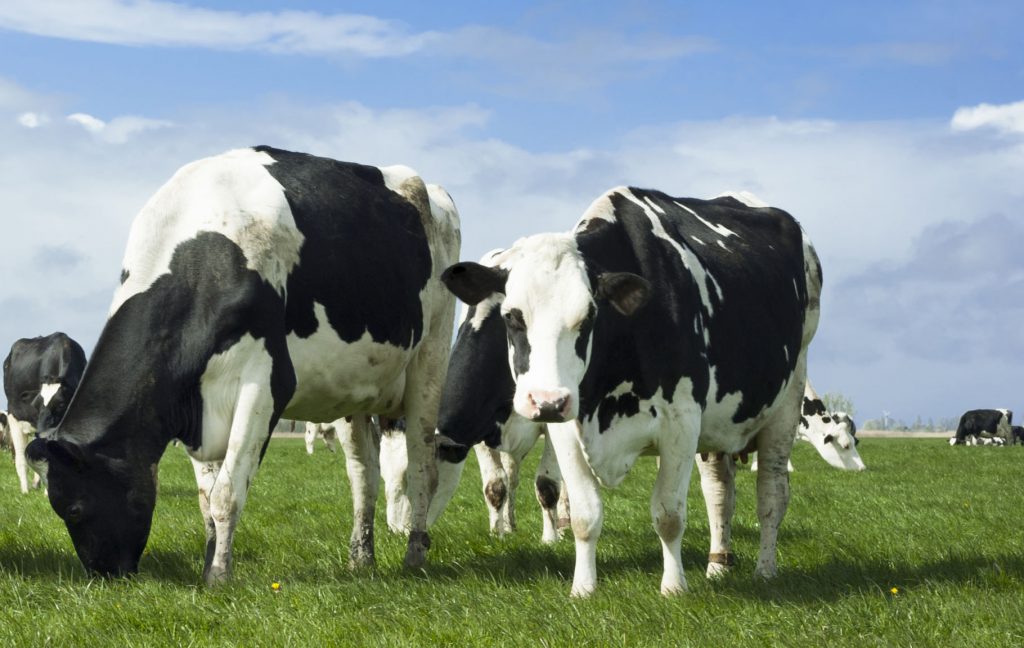
To conduct their study the researchers, as part of a collaboration with the Agri-Food and Biosciences Institute, worked with 29 Holstein-Friesian dairy cows.
The cows were given 18 days of overnight pasture access, as previous studies suggest it improves wellbeing.
And then 18 days of full-time indoor housing, that previous studies suggest harms welfare.
Each cow was then trained to approach a food rewarded bucket location, but not approach another, unrewarded bucket location.
After learning this task, to test judgement bias, the researchers presented cows with buckets in between the trained locations.
Approaching these intermediate buckets would reflect an expectation of reward under ambiguity – an “optimistic” judgement bias, suggesting positive emotional states.
The researchers found cows kept indoors full-time were faster to approach the known rewarded bucket location.
Andrew Crump, a postdoctoral researcher from the School of Biological Sciences and lead author of the paper, said: “Increased reward anticipation suggests that an animal has fewer rewards in its life.
“So our results indicate that pasture is a more rewarding environment for dairy cows, which may induce more positive emotional wellbeing than full-time housing.
“Britain and Ireland have mostly resisted the trend towards housing dairy cows indoors full-time.
“We hope that our research encourages farmers, retailers, government and consumers that pasture access is important for cow welfare.
“And should be protected. In countries where full-time housing is common, we hope that ours and other welfare studies challenge this trend.”
What the study uncovered
Allowing dairy cows to access pasture can promote natural behaviour and improve their health.
However, the psychological benefits are poorly understood.
The study compared a cognitive indicator of emotion in cattle either with or without pasture access.
In a crossover experiment, 29 Holstein–Friesian dairy cows had 18 days of overnight pasture access and 18 days of full-time indoor housing.
To assess emotional well-being, the cows were tested cows on a spatial judgement bias task.
Cows learnt to approach a rewarded bucket location, but not approach another, unrewarded bucket location.
The cows were then presented with three “probe” buckets intermediate between the trained locations.
Approaching the probes reflected an expectation of reward under ambiguity, an “optimistic” judgement bias, suggesting positive emotional states. The data was analysed using linear mixed-effects models.
There were no treatment differences in latency to approach the probe buckets, but cows approached the known rewarded bucket slower when they had pasture access than when they were indoors full-time.
These results indicate that, compared to cows housed indoors, those with pasture access display less anticipatory behaviour towards a known reward.
This reduced reward anticipation suggests that pasture is a more rewarding environment, which may induce more positive emotional states than full-time housing.
What consumers want and what they get
The study also found consumers have certain expectations of the dairy industry, and expect to see a picture perfect scene such as Holstein-Friesian cows grazing lush pasture on a summer afternoon.
Consumers overwhelmingly support pasture-based systems and oppose housing cows indoors full-time.
In several countries where intensive farming is active, such as Britian, 95% of the public believe pasture access benefits dairy cows.
That figure is 88% in Germany, 84% in the United States and Canada, and 81% in Brazil.
Industry stakeholders also value pasture access, noting its importance for cattle welfare.
However, housing cows indoors full-time facilitates feeding high-energy diets and increasing herd size on the same geographical area.
As a result, farmers across Europe and North America increasingly keep cattle indoors all year round.
In Denmark, Greece, and Poland, less than a quarter of dairy cows went out to pasture in 2019.
While in the United States, only 20% of lactating cows and 34% of dry cows accessed pasture.
However, some countries buck this trend.
Over 95% of British and Irish dairy cows went out to pasture in 2019, whilst Finland, Norway, and Sweden have banned full-time housing.
Worldwide, though, most milk now comes from dairy cows without any pasture access.
Dairy cows themselves also value pasture access.
Given the choice between pasture and housing, cows usually spend longer at pasture, particularly at night.
When pasture access requires walking long distances, or pushing weighted doors, cows appear to value pasture as highly as fresh food.
Sleeping and resting behaviour is strongly motivated and crucial for cow comfort.
Cows at pasture have longer lying bouts and are less restless. Softer lying and walking surfaces also reduce the risk of injuries, lameness, and mastitis.
Cubicle barns have limited space and localised resources, so herds at pasture are less aggressive and more synchronous.
Full-time housing does have some welfare benefits, such as protection from extreme weather, lower risk of gastrointestinal parasites, and greater control over nutrition.
Despite these advantages, several recent reviews have concluded that pasture access improves dairy cow welfare.
However, pasture’s importance for cows’ psychological well-being is poorly understood.
Well-being requires a favourable balance of positive and negative emotions.
Two dimensions characterise emotion: arousal, the intensity of activation, and balance, whether the state is pleasant or unpleasant.
In humans, for instance, both elation and terror are high-arousal states, but elation is positively balanced, whereas terror is negatively balanced.
Measures of cognition, physiology, and behaviour can reveal where animals fall along the two axes.
Based on these indicators, does pasture access induce positive emotions in dairy cows.
The report concluded, giving dairy cattle pasture access appears to induce more positive emotional states than cubicle housing.
Researchers previously showed that cows are more comfortable at pasture: they exhibit longer lying times, less restlessness, and greater herd synchrony.
These behaviour data are partially consistent with the present findings, collected during this most recent experiment.
Researchers found no difference in judgement bias between cows with and without pasture access.
However, in the judgement bias task, the pasture treatment was slower to approach a known reward.
This effect implies reduced reward anticipation, suggesting that cows in the pasture-based system had more rewarding lives.
Collectively, the results indicate that pasture access improves emotional well-being in dairy cows.
The Agri-Food and Biosciences Institute (AFBI) Hillsborough hosted the study.
This work was funded by Northern Ireland’s Department for the Economy, as well as a project that has received funding from the European Research Council (ERC) under the European Union’s Horizon 2020 research and innovation program.