With tariffs already being applied to farm produce in several markets the result appears to support heavy losses for farmers
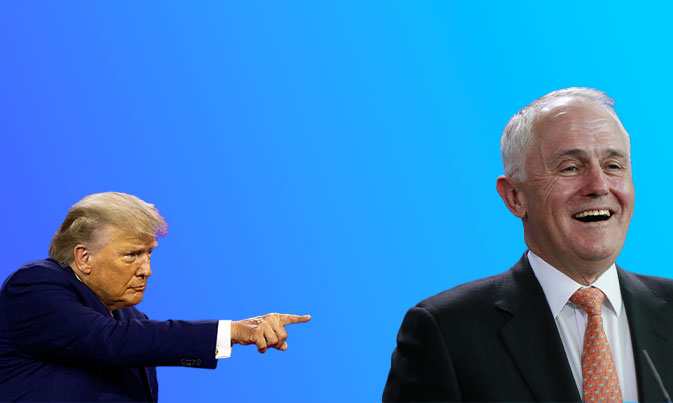
Until Australia’s former Prime Minister Malcolm Turnbull started an open spat with US president Donald Trump, it did appear local farmers might be spared from the devastating effects of tariffs.
But any advantage current Prime Minister Anthony Albanese may have thought he had in avoiding tariffs imposed by the US, with a now irate US president, is well and truly washed down the drain.
In an interview with Bloomberg Australia, former Prime Minister Malcolm Turnbull called US president Donald Trump “chaotic, rude, abusive and erratic.”
All terms not lost on a measured US president Donald Trump who reacted with, I always thought he (Malcolm Turnbull) was a weak and ineffective leader and, obviously, Australians agreed with me.”
The rebuke from the US president saw Malcolm Turnbull double down with in a later interview on ABC’s 7.30 when he said, “The idea of allies having to “suck up” to Mr Trump or join “the conga line of sycophants creeping through the White House” to avoid punishing tariffs was ludicrous.
“We cannot continue this bipartisan gas-lighting that is going on at the moment.
“The reality is that China’s Xi Jinping, will take advantage of Trump’s chaotic behaviour, and his harassing and bullying, seeking to extort allies,” Mr Turnbull added.
And while many farmers will simply shrug this scenario off as alter egos flexing at the highest level of power, the repercussions of tariffs will eventually sting their back pocket.
Even before the US weigh in with their imposts, a prime example of the damage that will occur is already playing out with a tariff tiff between China and Canada that comes into effect on 20 March.
China will apply a 100% tariff on canola oil and pea imports from Canada, and 25% on pork products and seafood.
And while this move by China might seem mighty unfair, it is in fact retaliatory, following Canada’s recent announcement of a 100% tariff on Chinese EVs and a 25% impost on any aluminium and steel products from China.
This tit-for-tat introduction of levies against previously harmonious trading partners is what can severely harm farm produce sales and, subsequently, farmer incomes worldwide.
The spat between China and Canada is the forerunner to what many industry pundits see as playing out in farm markets worldwide, and as a result, Australian farmers should not expect to be precluded.
The tariff crisis affecting Canadian farmers is entirely self-inflicted, according to many industry pundits, all due to the political game being played around EVs (electric vehicles) and ill-conceived tariffs on metals that have caused China to retaliate.
While other nations are working to ensure agricultural exports move efficiently to global markets and expand market access for producers to operate freely and competitively.
Farm commodities marked down
As a result of Chinese tariffs, Canadian farmers witnessed May canola futures on the ICE platform down $40 a tonne in just one day, as the immediate response.
It is widely expected the trade tariffs announced by China’s State Council Tariff Commission will cripple all exports of Canadian canola oil and pork products to China.
At stake are exports of Canadian farm produce to China valued at close to C$6 billion, leaving grain growers in particular with an unprecedented situation of trade uncertainty just weeks before planting begins in their region.
Canadian canola growers, in particular, are already asking their federal government for financial compensation to cover the huge losses they will incur at the farmgate.
Canadian US tariff uncertainty
The Canadian government was swift to follow the US line of 100% tariffs on Chinese EV (electric vehicle) imports and that has led to this no-win situation, a lesson of caution that could be well learnt for any other trading country.
With Canadian farmers facing severe losses from previous secure Chinese trade that amounted to their second-biggest market, it is ironic that mounting uncertainty with their largest export market, the United States is also on shaky ground with 25% tariffs earmarked.
Added together, US and Chinese export markets account for over half of all Canadian grain exports, a loss farmers cannot absorb at the farmgate or find a ready replacement in the short term.
And while the Government of Canada will immediately go into bat for their canola, pork and seafood producers the situation is only likely to be resolved with China if tariffs are withdrawn by both countries.
While the US will be a harder nut for Canada to crack, as it will be for Australian negotiators following the former Prime Minister Malcolm Turnbull and US president Donald Trump spat.