An updated table is the ideal tool to help growers protect pollinators and beneficial insects from overuse of chemicals

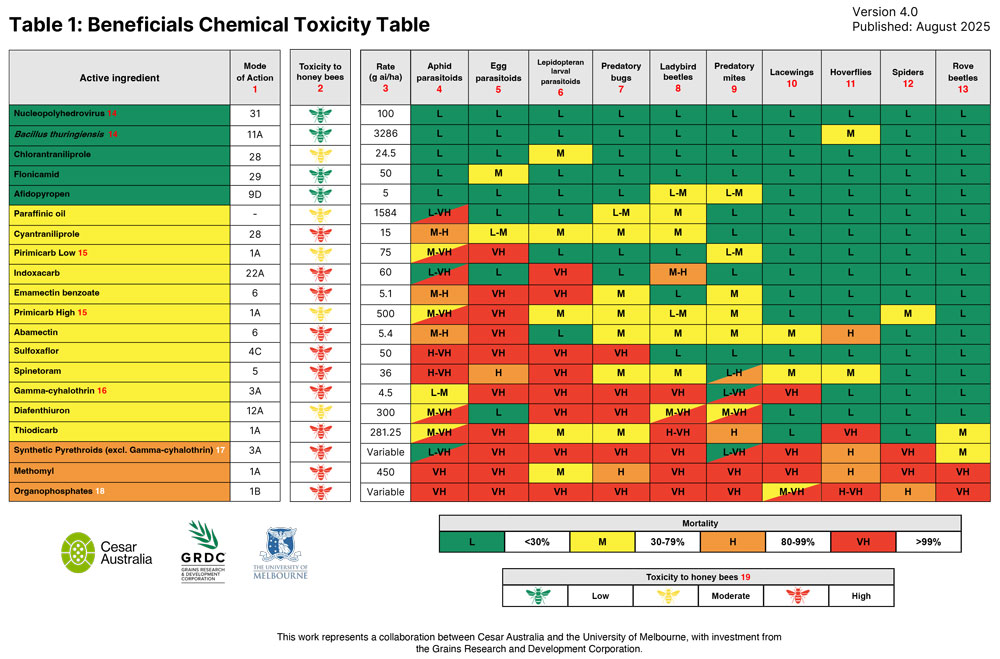
Grain growers and agronomists have an improved resource to help safeguard beneficial insects while managing pests with the launch of version 4.0 of the Beneficials Chemical Toxicity Table.
The table provides easy-to-use information on how different insecticides affect beneficial insects. Foliar insecticides can have off-target effects, inadvertently harming beneficial insects that provide natural services such as pest control and pollination.
The resource is an outcome of the Australian Grains and Horticulture Pest Innovation Program, a $24.79 million, five-year Grains Research and Development Corporation (GRDC) investment aimed at transforming pest management in Australian grain and vegetable industries.
The project is led by the University of Melbourne, with contributions from Hort Innovation and Cesar Australia.
Now, in response to industry feedback, the table reports European honeybee (Apis mellifera) toxicity data alongside the existing ratings for beneficial insects.
It was developed with input from industry and research partners together with independent laboratory testing to give growers and advisers a clear, single reference to the impact of insecticides on beneficials when making spray decisions.
GRDC Manager Pests, Dr Leigh Nelson, said the table is a valuable decision-making resource.
“Growers and advisers are already using the table to sharpen spray decisions, and that uptake is setting a benchmark for best practice across the grains industry,” Dr Nelson explained.
“They should continue to use the updated table to compare chemical options, selecting products that effectively target pests while minimising harm to beneficials, supporting natural pest control and protecting pollinator health,” Dr Nelson concluded.
Cesar Australia director Associate Professor Paul Umina said toxicity ratings for beneficial insects like predators and parasitoids were based on international laboratory testing guidelines using doses similar to those applied in the field.
“Honeybee ratings are based on Economic Co-operation and Development (OECD) testing data. These use LD₅₀ values – a measure of how toxic a product is to bees,” Professor Umina confirmed.
“This information should be treated as a guide. It’s useful for comparing products but needs to be considered alongside local bee activity and how and when chemicals are applied,” he added.
Find out how the Beneficials Chemical Toxicity Table Version 4.0 can help with spraying decisions, available now through Cesar Australia on this link.