We take a look at what types of farm operations benefited from high-value export income from the 2024-25 season for pointers to current 2025-26 season prospects

The value of agricultural exports continued to surge as the 2024-25 season progressed to reach $77.2 billion, with growth driven by a boom in the value of red meat exports to all-time highs.
The strong result for farm produce came amidst the backdrop of a rapidly shifting global environment driven by ongoing efforts by the US to reshape trade, according to Bendigo Bank’s Australian Agricultural Exports Report for 2024-25 with final export tallies.
The result represents the second-highest export year on record, following the record $79.2 billion in exports set in season 2022-23, confirming that the farm sector now accounts for 15.1% of Australia’s total exported goods.
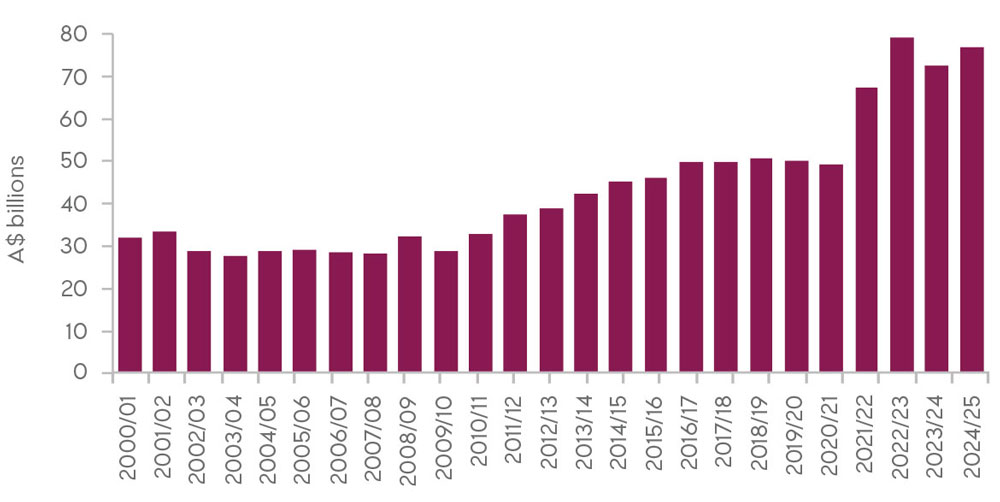
Looking ahead to the current 2025-26 season, it is expected that the value of farm exports will remain strong but early predictions point to a modest decline to $74.6 billion, the third-highest value on record, with some farm sectors subject to slight reductions while others prosper. See additional report here.
From the figured tallied from the 2024-25 season China remained the largest agricultural export market, accounting for 22.1% of total agricultural export value, while the US again recorded the largest year-on-year growth in exports, climbing a further 32.2% to become our second largest export market by a significant margin.
Another prominent market destination that continued to surge was India as it doubled in value to become our 6th largest export market.

All states, except South Australia and Western Australia, recorded an increase in export value through season 2024-25, while Victoria recorded a fourth consecutive year of growth to cement its title as the number one export state by a large margin.
Queensland maintained its position as the second largest exporter for a second consecutive season, while New South Wales recorded the largest year-on-year increase in export value, with Tasmania rebounding with the value of exports lifting 9.3% to almost a $billion, to a solid $979.3 million.
Industry observers noted the growth in farm exports was led by a lift in the value of livestock exports, with cattle exports smashing records, lifting almost 27% to $18.6 billion.
The value of sheep exports also increased $968 million to more than $6 billion, while horticultural exports hit a record $3.5 billion on the back of surging almond exports.

In comparison, cropping exports recorded comparatively modest growth, with a rise of $300 million amidst mixed production, with moderate growth in export value also recorded across the seafood, dairy, wine and fruit sectors.
The cotton, sugar, wool, and vegetable sectors were the only major agricultural sectors to record declines in export value during season 2024-25, each falling by between 3 and 17%.
Analyst for the current 2025-26 season factors in a possible decline in export value across the red meat sector, driven by lower volumes as favourable seasonal conditions see increased restocking and reduced slaughter rates.

While winter crop production should be broadly in line with the 2024-25 season, the value of cropping exports is forecast to see a slight decline due to reduced carryover stocks of barley and canola.
Despite the early forecast decline in value, the outlook for farm exports remains positive, with the total value expected to remain well above the five-year average, enabling robust value creation across the agricultural supply chain.
And while Trump administration tariffs currently favour Australia, our producers continue to capture a large portion of the additional US import demand for red meat, and this is expected to carry over into season 2025-26, at this stage.

How farm segment exports fared in 2024-25
Cattle Overview
• The value of cattle industry exports increased $3.9 billion, up 27% in 2024-25 to a record high of $18.6 billion.
• The primary driver of the growth in beef export value was the increase of $2 billion, up 58% to the US, as the continued reduction in US production led to stronger demand for Australian beef. Indonesia lifted to the highest level on record at $1.4 billion, while Canada doubled its imports to become our sixth largest export market by value.
• Australia’s cattle sector export value and volume are forecast to see a marginal decline throughout current season 2025-26 despite global demand for our beef remaining at elevated levels. Improved seasonal conditions are expected to drive a rise in restocker demand and retention of cattle, limiting slaughter rates and supply.

Cropping Overview
• The value of cropping exports was relatively stable in season 2024-25 at $22.7 billion, a modest rise of 1.3 per cent from the previous year. Pulses achieved the strongest growth, with exports climbing 46.6% to $3.9 billion underpinned by Indian demand.
• Wheat and barley exports declined in season 2024-25, but rising canola and chickpea shipments helped maintain overall cropping export values.
• The outlook for cropping exports in current season 2025-26 remains positive. Both volumes and values are expected to hold above five-year averages, underpinned by favourable production outlooks and firm demand across our key markets.
Dairy Overview
• The value of dairy exports reached a record high of $3.44 billion in season 2024-25. This is up 10% year-on-year and 18.8% above average.
• While volumes were also up year-on-year for most products, elevated global pricing meant record or near record average export prices drove gains in total value.
• Dairy export value is forecast to decline to around $3 billion in current season 2025-26, but still above average of $2.9 billion.
Global dairy prices are forecast to remain rangebound, while reduced Australian supply will limit export volumes in the coming season.
Horticulture Overview
• The value of Australian horticultural exports surged $759.7 million, plus 27.8%, to a record $3.5 billion in season 2024-25. This is 31.5% above the five-year average.
• Growth was driven by the fruit and nut sectors amidst favourable supply and demand factors. A favourable trade environment provided a further boost to the demand side of the equation amidst an increasingly positive trade relationship with China and an Australian dollar that remains well below the five-year average. Potatoes were another bright spot, up 13% for the fourth consecutive year of export growth.
• The outlook for Australian horticultural exports remains broadly positive in current season 2025-26 despite an expected reduction in overall value on the back of reduced almond and macadamia stocks.
Sheep Overview
• The value of sheepmeat exports lifted $925.5 million, up 19.3% in season 2024-25 to a record total of $5.7 billion with a record $1.4 billion of lamb landed in the US.
• Export value was driven higher by a sharp increase in mutton volume, particularly to China, while the average export unit prices of both lamb and mutton were significantly firmer.
• Australian sheepmeat exports are expected to be relatively steady in current season 2025-26, with the forecast decline in volume being mostly offset by an increase in prices.
Wool Overview
• The value of Australian wool exports fell $298.7 million, down 10.6% in season 2024-25 to a total of $2.5 billion.
• Despite prices generally increasing across the year, sluggish demand and reduced wool production saw export value decline for a third consecutive year.
• With wool production volumes predicted to drop to their lowest levels in over a century, wool exports are set to see another decline in value in current season 2025-26. Although prices have risen to start the season, it is not enough to offset the lower volumes and pressure from currency exchange fluctuations.

States that gained the most from exports in 2024-25
All states except South Australia and Western Australia, recorded an increase in export value during season 2024-25.
Victoria recorded a fourth consecutive year of growth to retain its title of number one exporter by a large margin. With strong growth in livestock, dairy, wine and horticultural exports the key drivers.
Victoria remained the largest exporting state, recording an 11.1% rise to a record $21.1 billion of agricultural exports as substantial cattle (+$1.3 billion), dairy (+$242 million) and horticultural (+$471 million) exports more than offset a $369 million decline in the value of cropping exports.
Queensland recorded its fourth consecutive year of record export value. Queensland saw growth of $2.2 billion, up 16.8% to maintain its position as the second largest exporter for a consecutive season with export value of $15.5 billion in 2024-25.
Growth in exports from Queensland were unsurprisingly boosted by the cattle industry, that saw a 20.7% increase and accounted for 59% of the state’s export value. Resurgent cropping exports were also seen across Queensland with the value of crop exports jumping 85.4% following a challenging season in 2023-24.
Western Australia recorded a decline for the second consecutive year, though this was a comparatively smaller decline, with overall export value falling $517.4 million, down 4.0 per cent to $12.5 billion. The bulk of this decline was driven by reduced cropping exports that fell by $554.8 million, down 6.1 per cent to $8.6 billion. This was partially offset by large increases in livestock, wine and seafood exports, at record levels.
New South Wales recorded the largest year-on-year increase in export value, with the state seeing growth in exports across almost all commodity groups, led by cattle and cropping that rose by $1.9 billion and $530 million, respectively. This resulted in a year-on-year rise of $3.1 billion, up 25% to a record $15.5 billion.
South Australia experienced the largest decline in export value, of $982.4 million to $7.6 billion, as drought took its toll on crop production. Cropping exports fell by $1.9 billion, while the livestock sector recorded significant growth.
Cattle industry exports jumped $444.1 million to $805.9 million, with sheepmeat exports also increasing by $149.4 million to $739.9 million. South Australian wine exports rose $216.9 million to $1.8 billion, the highest total since season 2019-20.
Tasmania recorded a rebound in export value after a challenging year in season 2023-24 with exports rising by $83.1 million to $979.3 million. The growth was primarily driven by resurgent seafood exports, up $147.7 million, while growth in the dairy sector was up $47.4 million, with sheepmeat at $31.1 million also adding value to the state’s overall export result.
Northern Territory agricultural export value increased for the first time since season 2019-20. A substantial increase in the quantity of live cattle exported to Indonesia and Vietnam drove a rise of $135 million, up 44.4% in export value, taking the Territory’s export value to its highest level since season 2020-21.
The main farm export by sectors 2024-25