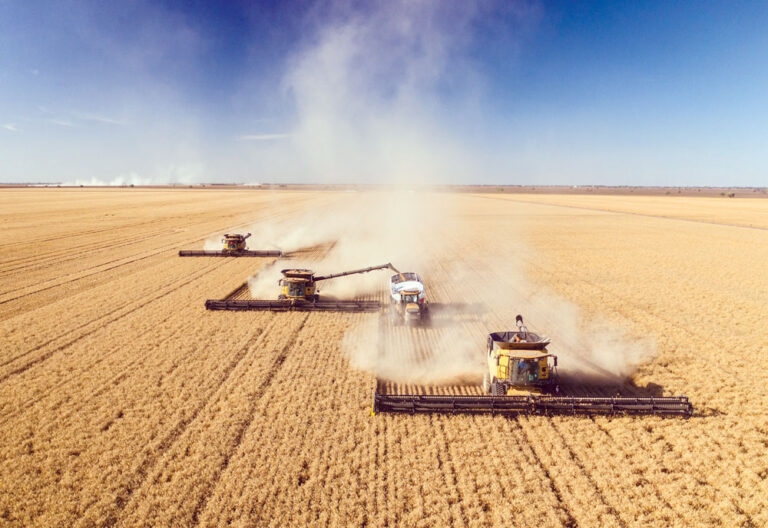
A report was released today at the Outlook 2023 Conference in Canberra that reveals how farm production in 2022-23 has eclipsed all previous records

A current snapshot of farm production shows the industry continues to grow and perform strongly in a number of key areas including exports where values are forecast to hit record levels in 2022-23, with cropping, broadacre and dairy farm cash incomes remaining well above benchmark levels.
Farming has withstood floods, fires and ravaging interest rates to grow farmgate produce to $90 billion in 2022-23, and in return made farmers rich with some sectors showing average yearly incomes from $370,000 to $665,000.
The total value of production from farm production, including fisheries and forestry, is $96 billion.
Agricultural exports are also forecast to set new records, reaching $75 billion in 2022–23. The first time we’ve seen our exports exceed $70 billion, which is a huge achievement.
National winter crop production has driven much of these results, with the winter crop estimated at a new record of 67.3 million tonnes in 2022–23. This beats last year’s record by 4 million tonnes and is being driven by exceptional results out of Western Australia and South Australia.
Production of wheat and canola is estimated to have reached new records, while we can expect the third-highest barley production on record.

High values of livestock production have also contributed to these record numbers, with producers increasing their production while also benefitting from historically high prices.
But it hasn’t been all plain sailing for farmers, with soaring machine retail prices and record prices paid for fertiliser that rose by 150% in some parts, and other inputs. Then there were banks taking their extra cut as the base cash rate rose.
Overall, it has been a hectic three years without a let-up where the value of farm gate production has broken records each year.
Of course, there have been some lucky breaks along the way, such as ideal growing conditions in many regions and higher-than-average commodity prices for grain and livestock meat in particular.
A record 67.3 million tonnes of winter crops were harvested over the 2022–23 season, that’s four million tonnes more than the previous record set in season 2021-22.
The states that came out best and with record hauls included Western Australia, South Australia, Victoria and Tasmania. While New South Wales growers had to be content with their fourth biggest haul on record and Queensland with their third biggest.
Western Australian growers had every duck sitting in a row to harvest the 25.6 million tonnes record, and when put into context it’s 61% higher than the 10-year average and 9% higher than the previous record of 23.4 million tonnes from the 2021–22 season.
Wheat growers scored best with a record 39.3 million tonnes, with Canola growers setting a new peak production line as well with 8.3 million tonnes, while Barley growers had to contend with the third largest haul on record at 14.1 million tonnes.
These results came off an area planted to winter crops in 2022–23 of 24 million hectares, a slight fall from last year. Driven partly by a 9% decrease in area planted in New South Wales and 11% in Queensland, due to extensive waterlogging that limited paddock access.

Farm incomes explode
This record result from farmgate production has also translated to additional farm incomes for the 2022–23 season, with the average cropping farm income soaring to $660,000.
Taken in perspective, growers in large-scale cropping operations have seen their farm income soar up to 75% above the 10-year average.
With Dairy farmers also reached new levels in 2022–23 to average incomes of $390,000, while broadacre farmers had to be content with an average of $371,000, down just a little on last year by around 7%, but still 46% above the 10-year average.
Western Australia
Winter crop production in Western Australia led the charge for 2022-23 with a forecast record of 25.6 million tonnes. This is 61% higher than the 10-year average to 2021–22 and 9% higher than the previous record of 23.4 million tonnes in 2021–22.
The record harvest reflects an estimated record area planted to winter crops, an excellent start to the winter cropping season, timely rainfall leading to sufficient soil moisture levels throughout the growing season, and minimal frost events.
Well-timed rainfall and mild spring conditions resulted in record-high winter crop yields. Cooler temperatures in spring allowed crops to fill grain slowly, further lifting yield potential. This has led to below-average protein levels, with a higher than usual share of wheat making the ASW and ASW9 (9% minimum protein wheat) grade.

The area planted to winter crops in Western Australia is estimated to increase slightly to a new record of more than 9 million hectares in 2022–23.
The strong price signal and excellent conditions during the planting window resulted in an increase in canola plantings, mostly at the expense of barley.
In northern cropping regions, the proportion of canola planted increased significantly from the previous season. The area planted to canola is estimated to be a record high of 2.1 million hectares, accounting for more than half of the national area planted for canola.
Despite a fall in the area , barley production is expected to be the second highest on record at 5.6 million tonnes. The average barley yield increased strongly given exceptional conditions, and a higher proportion of the barley crop was planted in high rainfall areas.
Winter crops WA 2022–23
Crop | Area ‘000 ha | Yield t/ha | Production Kt | Area change % | Prod. Change % |
| Wheat | 4,750 | 2.91 | 13,800 | 1 | 7 |
| Barley | 1,550 | 3.61 | 5,600 | –18 | –3 |
| Canola | 2,100 | 2.05 | 4,300 | 39 | 46 |
| Lupins | 400 | 2.31 | 925 | 14 | 23 |
New South Wales
Winter crop production in New South Wales is estimated to be 15.1 million tonnes in 2022–23. This estimate is 35% above the 10-year average to 2021–22 but 20% below the near-record production of last year. But still the second highest producing state.
The area planted to winter crops in New South Wales was 5.9 million hectares, 7% above the 10-year average to 2021–22 but falling by 9% compared to last year. Despite the significant flood impacts in the second half of 2022, it is expected that the 2022–23 winter crop will report the third highest yield on record.
An exceptionally wet start to the season in the Central West and north of the state significantly delayed planting, resulting in some fields being left fallow. Wet weather continued through the season with heavy rains in the Central West limiting growers’ ability to manage crops. Flooding around the Riverina, Murray and the Lachlan River also left many crops submerged for significant periods.
Despite this, drier weather over the summer months allowed flood waters to recede and many crops initially expected to have been a complete loss, were salvaged, significantly offsetting previous expectations of yield downgrades.
Many growers have been negatively impacted by flooding across the state and some quality downgrades are expected for wheat, barley and canola. In central and southern New South Wales, a higher than usual share of wheat made low protein and feed grades.
However, the quality profile of the wheat crop in northern New South Wales was excellent with an average share of wheat making high protein grades. Despite this total winter crop production is forecast to be the 4th highest on record.
Winter crops NSW 2022–23
Crop | Area ‘000 ha | Yield t/ha | Production Kt | Area change % | Prod. Change % |
| Wheat | 3,600 | 2.85 | 10,260 | 0 | –15 |
| Barley | 780 | 2.92 | 2,278 | –33 | –36 |
| Canola | 900 | 2.00 | 1,800 | –4 | –15 |

South Australia
Winter crop production in South Australia is estimated to reach a new record of 12.6 million tonnes, 19% higher than the previous record set in 2016–17. And enough to get SA into the placings as the third highest state production
Exceptional growing conditions during crop development supported the record volume of crop production, with yields in most regions faring better than anticipated. This comes as the state recorded its wettest and coolest spring since 2010. These wet and cool conditions prolonged the grain filling period, while the lower frequency and severity of frost events also contributed to record yields.
Crop harvests accelerated from late November after being delayed initially by earlier spring storms and rain across most cropping regions. Those weather delays, in addition to the record volumes to be harvested, pushed the harvest period well into January.
The wet spring did however cause some quality downgrades of early maturing crops but did not significantly affect the quality of most later maturing crops. Wheat qualities generally reached ASW (Australian Standard White) and APW (Australian Premium White) grades with much less downgraded to feed than in New South Wales.
Record yields on the Eyre Peninsula contributed to a higher occurrence of a dilution in grain protein, with most wheat harvested there reaching ASW grade. Accelerated adoption of genetically modified and hybrid varieties of canola contributed to lifting state average yields to a new record.
Winter crops SA 2022–23
Crop | Area ‘000 ha | Yield t/ha | Production Kt | Area change % | Prod. Change % |
| Wheat | 2,200 | 3.34 | 7,350 | 10 | 55 |
| Barley | 830 | 3.49 | 2,900 | –14 | 35 |
| Canola | 290 | 2.66 | 770 | 31 | 77 |

Victoria
Winter crop production in Victoria is forecast to reach a new record of 10.7 million tonnes in 2022–23, surpassing the previous record of 9.9 million tonnes in 2020–21.
This forecast incorporates crop loss and reduced crop prospects following the record October rainfall in Victoria that led to flooding events and waterlogging. Agriculture Victoria estimates crop area lost to be 218,640 hectares (6% of Victoria’s total winter crop area).
Satellite data shows central regions including the North Central and Goulburn Broken were the most severely impacted by the flooding (see Figure 3). Despite these impacts, the highest on-record yields are expected due to exceptional growing conditions in areas not impacted by flooding and waterlogging. Record production in Victoria also reflects near-record area planted to winter crops.
Record yields for winter crops were mainly driven by the Mallee and Wimmera growing regions, accounting for more than 60% of the area planted to wheat and barley across the state. Yields in these regions are forecast to be the highest on record due to the favourable start to the season and timely rainfall throughout most of the growing period.
For canola, there is a higher proportion of area planted in central regions where yields were negatively impacted by the excessively wet conditions. Prolonged wet conditions have also resulted in disease impacts including chocolate spot for faba beans, decreasing production.
Harvest activity in Victoria was prolonged due to the extremely high rainfall totals during October and November. In contrast, rainfall was average to below average during December and January, supporting the progress of harvest activity.
Drier conditions also contributed to less grain being downgraded to feed quality than initially expected.
Winter crops Victoria 2022–23
Crop | Area ‘000 ha | Yield t/ha | Production Kt | Area change % | Prod. Change % |
| Wheat | 1,500 | 3.60 | 5,393 | 4 | 27 |
| Barley | 820 | 3.53 | 2,896 | –6 | 28 |
| Canola | 600 | 2.30 | 1,383 | 5 | 6 |
Queensland
In southern Queensland, heavy rainfall and localised flooding at the start of the winter cropping season left many hectares fallow for summer crops.
Despite central Queensland being likely to have produced its largest winter crop in recent years, winter crop production in Queensland is expected to have decreased 12% in 2022–23 to 3.1 million tonnes.
This drop in production is largely due to a decrease in planted area, down by 11% to 1.4 million hectares. Heavy rainfall and localised flooding at the start of the winter cropping season prevented many growers from planting a full program.
Yields are also estimated to have decreased slightly year-on-year, with an estimated 37,000 hectares of crops impacted by flooding late in the season.
Winter crops Queensland 2022−23
Crop | Area ‘000 ha | Yield t/ha | Production Kt | Area change % | Prod. Change % |
| Wheat | 980 | 2.35 | 2,305 | 4 | 4 |
| Barley | 136 | 2.96 | 403 | –34 | –35 |
| Chickpeas | 200 | 1.46 | 292 | –32 | –42 |
Note: Yields are based on area planted. Area based on planted crop that is harvested, fed off or failed. Percent changes are relative to last year.
Source: ABARES