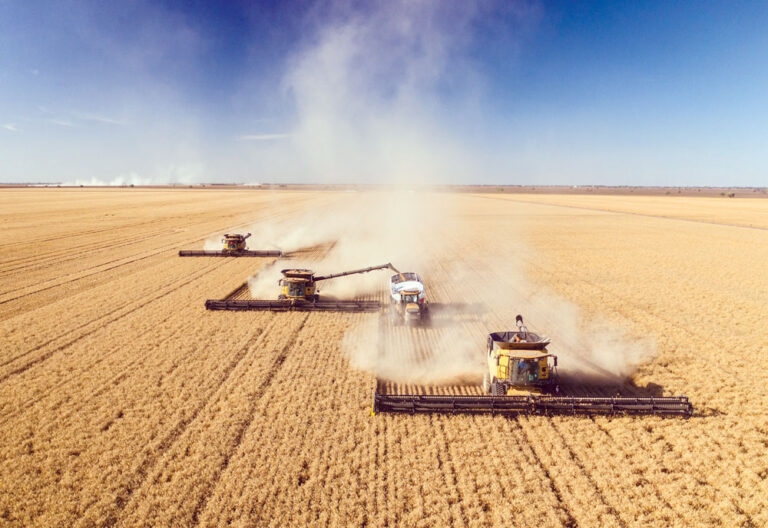
With Australia’s bulk grain exports reaching 40.6 million tonnes from the 2021–22 season it has exceeded the previous season’s record by 22%

A record grain export result followed what was a record set for local grain production in 2021–22 of 65.7 million tonnes, an increase of 11% on the previous record set in 2020–21.
At 40.6 million tonnes, Australia’s 2021–22 bulk grain exports exceeded last season’s record, of 33.3 million tonnes, by 22%. 2021–22 bulk exports were 61% above the average of 25.2 million tonnes. According to the most recent Grain monitoring report released today by the ABS.
Two consecutive years of record high-volume production created strong demand for export services throughout the season. Despite reports of issues getting grain to port, a record bulk export year was again set by industry.
Carryover grain from 2020–21 meant the 2021–22 season started strong, and record production meant bulk exports continued to remain well above average throughout the entirety of the season.
Increased capacity in on-farm storage in some regions is providing growers greater control over their marketing and transport decisions than in previous years, including when and where grain is delivered. As far as availability of grain deliver take a look at where the main bulk grain port terminals are situated on the map below that also shows the main grain growing regions.

Record breaking grain hauls
Two all-time-record winter grain harvests in a row put us in this position.
Locally grown grain production in 2021–22 reached a record 65.7 million tonnes, an increase of 11% on the previous record of 59.1 million tonnes in 2020–21.
Of the record-breaking total grain production, WA accounted for 35% of production with 23.1 million tonnes produced in 2021–22, followed by NSW accounting for 30% of production with 20.0 million tonnes.
It should be noted that for this year, season 2022-23, state proportions of total production are in line with average levels due to NSW producing more grain than WA in 2020–21.
Local growers also achieved record wheat production in 2021–22 reaching 36.3 million tonnes, surpassing the previous record of 31.9 million tonnes.
While Barley remained the second largest crop and production was almost at record levels, falling slightly to 13.9 million tonnes, down from the record 14.6 million tonnes produced in 2020–21.
Canola production across the country was also the highest on record at 6.8 million tonnes, breaking the previous record of 4.8 million tonnes set the previous year.
WA was the biggest canola producer, accounting for 47% of production, followed by NSW accounting for 27% of production. In 2021–22, all states had above average production levels.

Nationwide, 40.6 million tonnes of grain were exported via bulk shipments this season. This is 61% above average and 22% higher than the previous record set in 2020–21 (of 33.3 million tonnes).
Every state but SA set new bulk export records in 2021–22. SA’s bulk exports were 28% above average in 2021–22. WA was responsible for the largest share of exports at 18.2 million tonnes, followed by SA at 7.2 million tonnes, NSW at 6.2 million tonnes, Victoria at 6.0 million tonnes and Queensland at 2.9 million tonnes.
Every month in the 2021–22 season was well above average. The year had a strong start, likely driven by carryover from the bumper 2020–21 harvest and increased international demand for Australian exports during this period.
All months, except October, December and May, achieved record-breaking bulk exports for that specific month. In particular, September exports were 3.0 million tonnes, up 44% on the previous record set in 2011–12.
Additionally, November exports were 2.4 million tonnes, up 52% on the previous record set in 2011–12, July exports were 3.6 million, an increase of 40% on the previous record also set in 2011–12.
This year’s after peak period (June to September) represented an even larger proportion of total exports than 2020–21, with 34% of exports occurring after May (compared to 30% in 2020–21).
This demonstrates that demand for shipping capacity did not fall off after May but continued to remain high through the rest of the shipping year.

States that produce and export the most grain
Western Australia is Australia’s largest grain production and bulk export state, accounting for 35% of national production and 54% of total bulk shipments.
WA has a relatively low level of domestic grain consumption. In each of the last 8 shipping years, WA has had the second lowest level of domestic consumption in Australia of the wheat exporting states (with SA having the lowest). However, domestic consumption in WA has been increasing over the past 2 years.
WA has 5 bulk export port terminal facilities. Unlike other states, WA does not have any ports with multiple bulk grain export facilities.
CBH operates 4 facilities, located at Albany, Esperance, Geraldton and Kwinana. WAPRES operates a port terminal facility located at Bunbury. Kwinana consistently ships the most bulk grain of any facility in Australia.
Generally, WA’s shipment levels are less volatile than the eastern states. All of WA’s bulk export port terminal facilities are exempt from the Code. CBH received an exemption for each of its facilities from the Minister for Agriculture in 2014. The ACCC exempted WAPRES’s facility in 2015.
At 18.2 million tonnes, WA exceeded last year’s record bulk export season of 14.5 million tonnes by 26%, and was also 34% above average. Bulk grain shipments made up 89% of all grain usage, one percentage point above 2020–21 and average levels. Wheat made up 55% of 2021–22 bulk grain exports.
WA’s record bulk export season was driven by a record harvest. At 23.1 million tonnes, the 2021–22 harvest was 30% larger than the previous record of 17.8 million tonnes in 2016–17.
Additionally, 2021–22 production was 40% larger than 2020–21 (a then record bulk export season), and 42% above the average of 16.3 million tonnes.

New South Wales is typically Australia’s second largest producer of grain, behind WA. This held true in the 2021–22 season, with NSW accounting for 30% of national output, compared to 35% for WA.
NSW has continued to be Australia’s largest consumer of domestic grain, consuming on average 4.9 million tonnes of grain.
In the 2021–22 season, NSW consumed 5.8 million tonnes of grain, 36% of national consumption.
Despite being the second largest producer of grain, NSW is the second smallest bulk grain export shipment state, only Queensland exports less.
NSW is typically the second highest containerised export state, behind Victoria, and this remained the case in 2021–22, with NSW exporting 1.2 million tonnes of containerised grain.
A substantial amount of grain produced within NSW is also typically transferred to Queensland and Victoria both for domestic consumption and export.
NSW has 4 facilities located across 2 different ports. GrainCorp operates port terminal facilities at Carrington (Newcastle) and Port Kembla. Newcastle Agri Terminal (NAT) operates a facility in Newcastle and Quattro operates a facility at Port Kembla.
NSW achieved record bulk exports levels in 2021–22 exporting 6.2 million tonnes of grain, breaking the previous record set last year of 5.7 million tonnes. Of the 6.2 million tonnes exported, 75% was wheat and 25% was non-wheat grain.
Bulk grain exports accounted for 47% of all grain usage, which is significantly above the average of 24%.
NSW produced a bumper harvest of 20.0 million tonnes in 2021–22. This was NSW second largest harvest on record, after last year’s record harvest of 21.1 million tonnes.
NSW has a strong containerised export market. In 2021–22, 1.2 million tonnes of grain were exported via containers, 52% above average. NSW is the largest domestic consumer of grain in Australia and in 2021–22 consumed a record 5.8 million tonnes of grain, an increase of 6% from last season’s then record of 5.4 million tonnes.
South Australia had the highest number of operational bulk grain export port terminal facilities in Australia in 2021–22 (9). SA has a strong bulk shipment focus, with bulk shipments accounting for 76% of SA’s grain usage.
At 7.2 million tonnes SA achieved its third largest bulk export season on record in 2021–22, 28% above the average of 5.6 million tonnes. 2021–22 exports were 11% below SA’s record 2016–17 season of 8.1 million tonnes. Wheat made up 59% of bulk exports in 2021–22.
SA’s achieved its second largest harvest on record.25 At 8.4 million tonnes it was 15% above average.
Four of SA’s 9 operational port terminal facilities in 2021–22 was located at Port Adelaide.
Viterra operates 2 Port Adelaide facilities (Outer Harbor and Inner Harbour), while Cargill and Semaphore Container Services both operate mobile ship loaders at Port Adelaide (commenced in 2020–21 and 2016–17 respectively).
Viterra operates 4 of SA’s remaining 6 facilities, located at Port Lincoln, Thevenard, Wallaroo and Port Giles. The other facilities are T-Ports’ facility at Lucky Bay (commenced operations in 2019-20) and ADM’s mobile ship loader facility at Port Pirie (which was not operational in 2021–22).