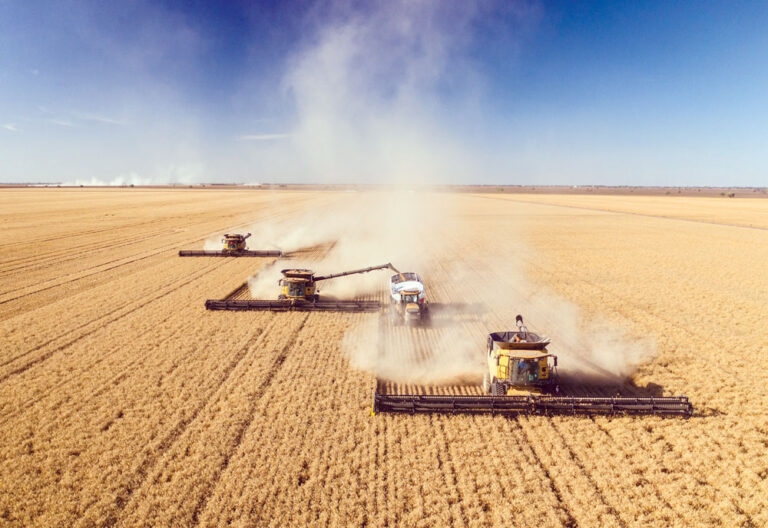
Western Australian New South Wales and Queensland growers burst their on-farm storage capacity to the seams during the 59.8 million tonnes 2024-25 winter grain harvest

Back in October 2024 winter harvest predictions for season 2024-25 of 55.2 million tonnes placed growers in a secure position at 17% above the 10-year average.
But with the 2024-25 winter harvest now locked away, we can reveal growers have managed an even more creditable 59.8 million tonnes, this is 27% above the 10-year average to 2023-24 of 47.1 million tonnes and is the third highest result on record.
And all but two states Victoria and South Australia managed hefty upswings on the previous winter crop.
Growers in New South Wales, Queensland and Western Australia could place an order for the priciest Ute and their bank managers wouldn’t blink an eye.

The 2024-25 winter crop contributed to the gross value of agriculture production, including grain and livestock to reach an estimated $92 billion, the second highest combined value on record, an increase of $9.6 billion over 2023-24.
And from this result, farmers will have an estimated combined value of $73 billion in excess production not required by the domestic market that can be sold into overseas markets.
Here is the final tally state-by-state for the 2024-25 winter crop, that was primarily boosted as the result of a planting record of 24.9 million hectares.

Western Australia
Winter crop production in Western Australia in 2024-25 increased by 55% to 23.0 million tonnes over last year, to be the third highest on record for WA. This represents a 19% upward revision from earlier predictions and sits at 34% above the 10-year average to 2023-24 of 17.2 million tonnes.
This near-record harvest reflects an estimated expansion in area planted to winter crops of 8.7 million/ha and above average yields.
Following a dry start to the winter cropping season, favourably timed rainfall events during winter saw growing conditions improve significantly, especially across northern cropping regions of Western Australia.
Despite below average rainfall during September and October 2024, a combination of factors including warm growing conditions led to fast crop growth.
While high water use efficiency, minimal frost events during the grain filling period, and lack of waterlogging in high rainfall areas, all resulted in higher yields than initially forecast.
The better-than-expected harvest results can also be attributed to improved farming practices and advancements in seed varieties.
Overall, the quality profile of the Western Australian wheat crop was heavily weighted to lower protein grades, with some quality downgrades due to wet harvest conditions across central and northern cropping regions.
Wheat production in Western Australia increased by 64% to 12.7 million tonnes in 2024-25, sitting 34% above the 10-year average to 2023-24.
The average WA wheat yield increased by 64% to 2.69 tonnes/ha. A good result from the 4.7 million/ha planted, up just 1.1% on last year.
Barley production is estimated to have reached a record level of 6 million tonnes, driven by higher area plantings of 1.8 million/ha, up 12.5% on last year.
While near record yields of 3.33 tonnes/ha was an increase of 62% over last year.
Despite an estimated fall in area planted to 1.6 million/ha, canola production increased to 2.9 million tonnes to be the third highest result on record for WA growers.
With canola yields at 1.81 tonnes/ha the crop achieved an increase of 16% over last year. Lupins continue to gain momentum with WA growers, with an estimated 0.35 million/ha, planted with a yield of 1.67 tonnes/ha. Leading to a production total of 0.58.5 million tonnes

New South Wales
Everything was running so well for NSW growers they looked likely to be the top producers from the 2024-25 winter crop, with early season expectations of a 50% increase over last year.
Those predictions were later gazumped with a rise of 79% to 20.3 million tonnes in winter season 2024-25. This result is the second highest production level on record for NSW and 72% above the 10-year average to 2023-24.
The area planted to winter crops in NSW rose to 7.1 million hectares in 2024-25, up 27% when compared to last year and 28% above the 10-year average to 2023-24.
Increases in area planted to winter crops reflect above average subsoil moisture across much of northern and central New South Wales at the time of planting.
Additionally, high chickpea prices following the temporary removal of Indian tariffs on Australian chickpea imports, incentivised growers to increase chickpea plantings.
Northern and central New South Wales experienced favourable growing season rainfall. By contrast, southern growing regions experienced a dry start to the season with some areas impacted by frost events.
However, average to above average rainfall throughout October and November 2024 supported a recovery in yields across these cropping regions.
As a result, the 2024-25 winter crop production in NSW has seen an upwards revision of 6% from the previous seasonal forecast.
New South Wales wheat production has risen by 82% in 2024-25, to 12.9 million tonnes, with the average state yield 48% above the 10-year average to 2023-24.
The area planted for wheat in NSW was 3.9 million/ha, with a yield of 3.31 tonnes/ha.
Barley production in NSW gained an overall rise of 77% to 3.4 million tonnes from a planted area of 1.00 million/ha, with a yield of 3.4 tonnes/ha.
The overall quality across wheat and barley was high early in the harvest with some malting barley available. However, late rainfall events in December 2024 delayed harvesting and impacted the quality of some crops late in the harvest.
Canola production jumped by 13% to 1.8 million tonnes in NSW from increased plantings of 0.98 million/ha, but with yields down a little as the season progressed to 1.84 tonnes/ha.
Chickpea production in NSW reached a record level of 1.3 million tonnes, 272% above the 10-year average to 2023-24.
Mainly due to a 287% increase in area planted by NSW growers of 0.58 million/ha and strong yields of 2.21 tonnes/ha to realise the metrological rise in chickpea production.

Victoria
Conditions went from ordinary, then bad to worse for Victorian growers as expectations later in the season were for a production level of 8.6 million tonnes from the 2024-25 winter crop.
But it got worse again and season production for Victorian growers fell by 31% over last year, to only harvest 7.4 million tonnes in 2024-25.
This represents a level of 7% below the 10-year average to 2023-24 of 7.9 million tonnes. Blamed by growers on the below to very much below average growing season rainfall in northern and western growing regions, reducing yields.
An unfavourable start to the season meant a high proportion of winter crops were sown dry, with area planted estimated to be 3.6 million hectares, a costly 6% above the 10-year average to 2023-24.
Winter crop yields were 11% below the 10-year average, attributed to the largely unfavourable growing conditions throughout the season.
Lower than expected rainfall and widespread frost events in September 2024 also affected crops, with instances of wheat and barley being cut for hay across major cropping zones in the Mallee and Wimmera.
However, average to above average rainfall during October and November 2024 in the North Central and Goulburn Broken cropping regions supported grain fill and arrested any further yield declines in those areas.
Harvest activity was prolonged in some central and southern regions of Victoria due to wet conditions recorded in late November and early December 2024.
Despite wet harvest conditions, overall grain quality was reportedly better than expected, with better-than-expected protein levels for wheat as well as malting percentages for barley given the seasonal conditions.
Wheat production in Victoria fell by 33% to 3.5 million tonnes in 2024-25, and that placed it 8% below the 10-year average to 2023-24.
The area planted for wheat in VIC was 1.50 million/ha, down just 2.6% on last year. And that along with the low yield of 2.33 tonnes/ha, severely dented production.
Barley production also fell, by 28% to 2.0 million tonnes, sitting it 13% below the 10-year average to 2023-24.
Growers were cautious from the outset and only planted down an area of 0.82 million/ha of barley, an area drop of 28% over last year. While the weak yield of 2.44 tonnes/ha also contributed to a reduced harvest.
Canola production followed the general theme to be down 34% to 900 thousand tonnes, but even so still sits in line with the 10-year average to 2023-24, mainly due to the above average area planted.
The area planted for canola in VIC was 0.52 million/ha, and the yield at 1.73 tonnes/ha was a further dent to production of 0.95 million tonnes.
Lentil production also fell by 31% to 535 thousand tonnes; however, production remained 58% above the 10-year average to 2023-24 reflecting a 13% increase in the area planted.
As the season went on, the increased area planted for Lentils at 0.43 million/ha proved to be a false hope as the yield died away to realise just 1.24 tonnes/ha to show a weak production total of 0.535 million tonnes.

South Australia
With a very dry start to the season there was plenty of caution around how much crop to plant by growers in SA, and an early season production forecast of 7.9 million tonnes seemed reasonable from the persistent dry conditions across most cropping regions.
But for SA growers the wishing well dried up, and forecasters had to content with a reality check of a 40% fall from last year to harvest just 5.3 million tonnes in 2024-25. This puts production at 34% below the 10-year average to 2023-24
Looking back at this disastrous season in SA, rainfall totals between April and November 2024 were very much below average for most winter cropping regions of SA, significantly impacting yields.
Late crop emergence, above average spring temperatures and several frost events further compounded the lack of in growing season rainfall.
Despite these extreme challenges, it has been noted that improved farming practices that conserve moisture and improve water use efficiency together with advancements in seed varieties has resulted in higher-than-expected yields considering the season.
South Australian wheat production fell by 42% in 2024-25, to 2.8 million tonnes, with the average state yield 40% below the 10-year average to 2023-24.
Not many growers got away clean as wheat plantings of 2.05 million/ha was only 4.7% down on last year. And yields hovered around poverty levels of just 1.35 tonnes/ha.
Barley production took a tumble to fall by 37% to only get 1.3 million tonnes to the silos.
This was a big blow as SA growers planted down an area of 0.81 million/ha of barley, around the same as last year. While the yield of 1.60 tonnes/ha was also in no-man’s land territory.
Canola production struggled to get a foothold and ended up down by 43% over last year for a production return of only 325 thousand tonnes.
Not many growers were cautious with their canola plantings as 0.26 million/ha went into the ground, just 7.1% shy of last year. Coupled with a yield of just 1.25 tonnes/ha the production total was a mere 0.32 million tonnes.
Lentil production is down 27% year on year but remains 36% above the 10-year average at 555 thousand tonnes, reflecting a 21% increase in the area planted.
Many SA growers put their weight behind the so-called lentil boom where big returns were expected and as a result 0.47 million/ha was planted. But yields were weak at 1.18 tonnes/ha to only reach a production total of 0.55 million tonnes.

Queensland
Growers in Queensland realised an increase of 122% over last year to reach a production level of 3.8 million tonnes in 2024-25, their highest level on record for a winter crop.
This result is 85% above the 10-year average to 2023-24 of 2.0 million tonnes and represents a major turn-around from the disastrous season last year after which QLD growers had to beg their bank managers for funds to plant down a crop in 2024-25.
Part of this upward result is attributed to higher yields and greater area planted to chickpeas than previously.
The overall increase in winter crop production reflects a year-on-year expansion in area and above average yields for all major winter crops, supported by adequate rainfall and high soil moisture levels at planting and during the growing season.
Queensland wheat production has increased over last year by 106% to 2.2 million tonnes in winter season 2024-25, with average state yield 42% above the 10-year average to 2023-24.
Growers could smell the profit in the air as they dug down an additional 25% of with wheat plantings at 0.90 million/ha, and then be rewarded with strong yield levels of 2.48 tonnes/ha.
Barley production also increased by 78% to 535 thousand tonnes, with the average state yield at 34% above the 10-year average to 2023-24.
Many QLD growers banked on barley and increased plantings to an area of 0.18 million/ha, and were pleasantry surprised to realise a yield of 2.89 tonnes/ha for a production total of 0.53 million tonnes.
Chickpea production increased by a dramatic 239% to 950 thousand tonnes in 2024-25, the second highest level on record for QLD growers, with an average state yield 74% above the 10-year average to 2023-24.
The area planted to chickpeas is estimated to have increased by 91% in winter season 2024-25, supported by favourable seasonal conditions at planting and elevated chickpea prices.
The area planted for chickpeas in QLD was 0.42 million/ha, and with that increased growing level came a memorable yield of 2.26 tonnes/ha for a final production total of 0.95 million tonnes.