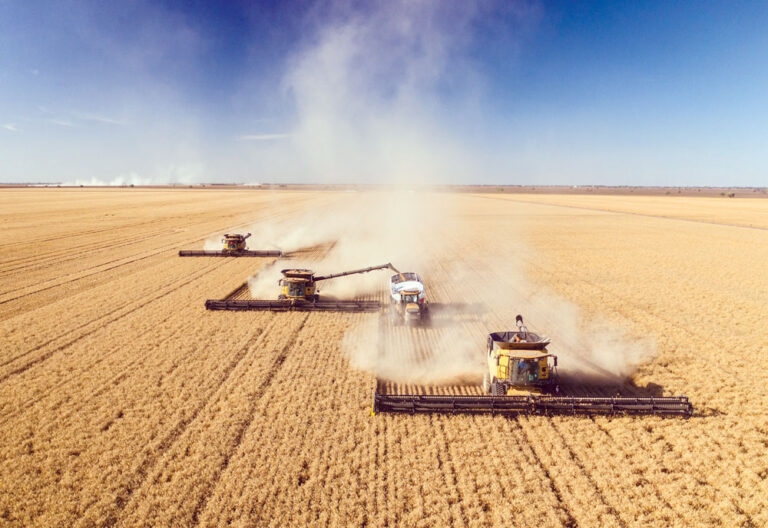
Predictions for a hit to the winter crop harvest continue as Rural Bank gives its assessment of the season ahead for grower fortunes

Once all the crystal ball gazers start drinking from the one trough it’s hard to get a varying second opinion.
And that’s the case with winter harvest predictions for season 2023-24, even though it is expected by most that the area planted to crops will likely be at record levels.
Rural Bank has now weighed in with its predictions of what growers can expect from their record plantings, and it’s not a pretty sight with total production forecast to come in slightly above the ten-year average. And that would be a major failure from a record planting.
But there is a very real possibility the experts are off their game this season, relying too heavily on the impact of El Niño dry weather predictions that at this stage have not been called by The Bureau, instead, issuing an alert only at this stage. And like many others, do not expect an El Niño event to reveal itself before summer.
See what CSIRO researchers have to say, as they weigh in with their view on the significance of the possible El Niño conditions warning on this link.
If the next El Niño event doesn’t hit before Summer, the winter harvest will not be as heavily impacted as the experts are suggesting, however for those that want to heed the warning from Rural Bank here is the bad news they are expecting.

Rural Bank forecasting
Rural Bank indicates current forecasts show there is now a 70% chance of an El Niño and positive Indian Ocean Dipole forming in 2023 which drive both hotter and drier conditions across the east coast of Australia.
As a result, Rural Bank expects this drier seasonal outlook will weigh on production outcomes with winter crop production expected to fall from the record output recorded last season, and to come in slightly below average. Even though they admit a strong autumn break and timely rainfall in early June have supported a strong start to the season.
The reasoning behind reduced supply
Rural Bank projects winter cereal production to fall from record highs under expectations of below average rainfall for winter and spring.
Forecasting wheat production to fall by 34% to 26.2 million tonnes, slightly below the 10-year average. While they also forecast barley production to fall by 30% to 9.9 million tonnes and place the crop around 11% below the 10-year average.
Rural Bank acknowledges the planting program has progressed well in most states after growers opted to utilise soil moisture from good rainfall received in March and April and sow their crops early.
Overall germination and crop establishment have been good, although dry conditions in parts of northern New South Wales have negatively impacted crops in the region.
After getting off to a good start, the downside risk to this season’s crop is the potential for an El Niño and positive Indian Ocean Dipole event to both form later this year. These two events combined typically suppress rainfall in eastern Australia during the winter and spring months.

According to Rural Bank, the USDA has forecast global wheat production to increase slightly from last season to a record 800.2 million tonnes. With reduced production in Australia, Russia and Ukraine to be offset by increases in production across Canada, Argentina, and the European Union.
Given assumptions for global use, global carry-out stocks are expected to increase from 266.7 million tonnes in the current season to 270.7 million tonnes in 2023-24.
Of greater importance according to Rural Bank is the stocks forecast for the eight major global exporters. This volume is calculated at 62.2 million tonnes, falling for the sixth time in the past seven years.
Internationally we are moving into the sweet spot for finishing northern hemisphere winter crops and critical time for spring sown crops, so weather risks become more dominant now.
Rural Bank reminds us how markets have been heavily sold on the back of increased new season supply potential, any thoughts of cuts to new season supply will see markets reverse quickly.

Meeting the demand
Wheat exports have been at a record pace during 2023 aided by Asian buyers substituting corn with Australian feed wheat.
Demand is expected to remain strong for the remainder of the 2022/23 marketing year with the final wheat export figure estimated at a record 29 million tonnes. Australian wheat exports for the 2023-24 season are estimated at 21 million tonnes on the back of the lower production outlook.
However, Rural Bank expects decreased production in key exporting nations along with continued strong global demand will see export opportunities remain positive for Australian wheat.
Export volume expectations
Rural Bank expects Barley exports for 2022-23 to reveal a drop of 11% year on year to 7.3 million tonnes.
While strong demand for feed barley from domestic users on the east coast has led to negative export margins, a function of the premium they have been paying over export parity.
This will see combined exports from New South Wales and Victoria decline by 900,000 tonnes from the previous season. Australian barley exports for the upcoming 2023-24 season are estimated at 5.5 million tonnes on the back of the lower production outlook.
It is widely believed that China’s tariff on Australian barley will be lifted in the coming months. Should this eventuate, it will have large ramifications for this market with domestic barley prices expected to move sharply higher.
The opening would also reduce Australia’s exposure to inverted northern hemisphere markets, where prices are lower in July and August as new crop Black Sea and European barley is harvested and sold.

Price expectations
Rural Bank reminds us that global wheat prices have fallen 21% for the year to date and 57% since hitting an all-time high in March 2022, last year.
Last July’s Back Sea grain corridor deal and its subsequent extensions have allowed Ukraine to export grains through Black Sea ports, easing concerns over world supplies.
Australian wheat prices have held up comparatively well, dropping around 13% since the beginning of the year. Global prices are expected to fall further in 2023-24 because of the expected rising global grain production.
Whether local wheat prices follow will depend on the outcome of local production, though generally Australian wheat prices are expected to stay elevated and trade at historically high values over the coming six months.
Australian Premium White (APW) grade wheat is forecast to trade between $350 to $400 per tonne over this period. With ongoing strong demand from Asia, and in particular, China will continue to support prices.
Barley prices are anticipated to average $250 to $290 per tonne over the outlook period out of the export-oriented states of Western Australia and South Australia. Queensland and northern New South Wales are trading at a premium to this on diminishing supplies and continued strong demand from domestic feed users.
If conditions turn dry, prices will push higher as the domestic market rations demand back.
The forecast for barley prices from Rural Bank at this stage does not consider the possibility of successful negotiation with China and the lifting of tariffs.
At current international values, China access would add around $50 per tonne to barley export prices.

Oilseeds expectations
While the area planted to canola is forecast to decline 11% to 3.5 million hectares, this still remains the second-largest area on record.
The decline in canola prices from their highs a year ago is making it a less attractive crop to grow due to its high input costs.
Growers took advantage of early-season rainfall with most major canola regions getting the crop planted and established while soil temperatures were still warm.
Below average rainfall in May put some stress on developing crops. However, ideally timed rainfall in the first week of June across southern Australia has topped up these crops and still sees production potential at least average on Rural Bank predictions.
However, Rural Bank is forecasting Canola production to fall by 41% to 4.9 million tonnes in 2023-24. With an above average carry-out forecast at 2.0 million tonnes, of which Western Australia will account for around 80%.
Australia will have an exportable surplus of around 5.1 million tonnes under current production estimates.
Rural Bank points out the USDA estimates global canola production will fall one per cent from last year’s record crop to 87.2 million tonnes. With both Canada and the European Union projected to produce above average crops this season.
This will see Australian canola prices come under pressure as it faces competition from increased Canadian exports. While the European Union, a major consumer of Australian canola, is expected to see imports drop by 1.8 million tonnes to 5.1 million tonnes, a five-year low.
Rural Bank expects fundamental supply and demand factors will put downward pressure on canola prices through to 2024. This will see canola prices trading back around historical averages of between $550 and $650 per tonne.

Pulses are still a favourite
Planted area to pulses is seen steady year on year with mostly favourable seeding conditions allowing growers to plant full programs. Rural Bank forecasts of a return to average yields have pulse production declining 32% from last year to 2.7 million tonnes.
Chickpea area planted is forecast to rise 15% from last year to 457,000 hectares and production is forecast to increase one per cent to 544,000 tonnes.
Lentil exports are on track to surpass one million tonnes this season with India the prime destination. Australian lentil exports to India will continue to benefit from a zero tariff until at least 31 March 2024.
With prices to stay supported at over $800 per tonne, some buyers are indicating they will need to start pricing again, as they still have vessels to accumulate for in the coming months.
With AgPulse Analytica putting the 2023 global red lentil production at over 7 million tonnes, up from 6.7 million tonnes in 2022, a large upside in price could be hard to achieve in the medium to long term unless there are production issues.
Current faba bean exports are five per cent behind the same time as last year at 196,000 tonnes. Australia has put less product into Egypt this year compared with the previous two because of Egypt’s currency difficulties.
On the global front there are no major crop concerns to add any price support, with reports that European crop conditions are overall positive, with France and the UK the major competitors against Australian beans.
Without export interest picking up, Rural Bank suggests it does seem supply could outstrip domestic demand before harvest. Delivered Melbourne prices are expected to trade around $400 per tonne for the rest of the year.
Following strong enthusiasm from growers to plant record crop seed for season 2023-24 with high moisture levels backing their decisions, it’s grower experience and instincts versus experts’ opinions when it comes to harvest results for the season.