Drought hardy annual ryegrass raises a major weed management challenge as it evades current controls
Research findings confirm annual ryegrass is currently the most damaging weed in our grain growing systems, as it is clever enough to adjust its growth and reproduction to survive under drought stress.
A study into how annual ryegrass is it potentially harder to manage as climate conditions become more variable, and the cost to growers through a season has been undertaken by La Trobe University.
Annual ryegrass (Lolium rigidum) has evolved into the most problematic and economically damaging weed in a crop rotation because of its competitiveness, prolific seed production and widespread herbicide resistance.
It is estimated to cost grain growers has topped $93 million a year, including grain yield losses and cost of control measures.
To better understand how the weed adapts to drought stress, researchers at the La Trobe Institute for Sustainable Agriculture and Food (LISAF) and the School of Agriculture, Biomedicine and Environment (SABE), examined how herbicide-resistant and herbicide-susceptible populations of ryegrass responded to various soil moisture levels.
They found that moderate water limitation did not simply suppress ryegrass growth, but in some cases stimulated the weed’s development, with the resistant population producing up to 132% more leaves and 153% more tillers compared with saturated conditions.
And while severe drought reduced plant height, root and shoot biomass, and seed production of the herbicide-resistant ryegrass population by up to 50%, the plants were still able to survive and reproduce.
In addition, the annual ryegrass showed greater flexibility in flowering time and maintained higher leaf water content under stress, suggesting it may be better equipped to persist in water-limited environments.
This confirms annual ryegrass remains a serious threat even in drier seasons, particularly where herbicide-resistant populations already occur.
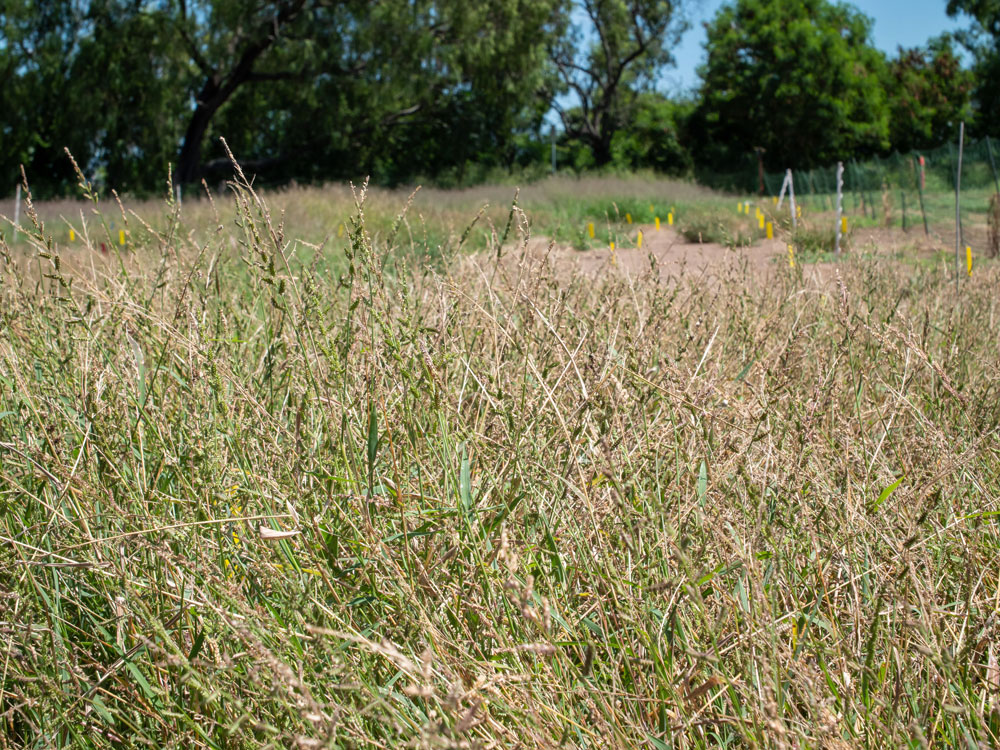
Research underpins drought resilience
Lead author Dr Ali Bajwa, Senior Lecturer in Weed Science and Agronomy, confirmed the findings highlighted the need to rethink weed management in the face of climate variability.
“Annual ryegrass is already one of the most difficult weeds for grain growers to control, and our study shows it has a strong capacity to adjust to moisture stress,” Dr Bajwa explained.
“The fact that the resistant populations can grow more vigorously under moderate drought and still produce seed under severe stress means growers need management strategies that are tailored to local weed populations and seasonal conditions.
“Resistant population did not show any major fitness cost and in fact, performed better under stress, which could be a double whammy for grain growers who are already having to deal with other herbicide resistant plants that are also drought hardy.”
Dr Bajwa outlined how the findings reinforced that there was no one-size-fits-all solution to managing annual ryegrass.
“Understanding how different ryegrass populations respond to drought can help growers and advisers design more targeted strategies to reduce seedbank build-up and limit the spread of difficult-to-control populations,” Dr Bajwa added.
“We need further research on greater number of populations under field conditions in order to future proof our weed management programs in grain production in the wake of seasonal variabilities and changing climate.”