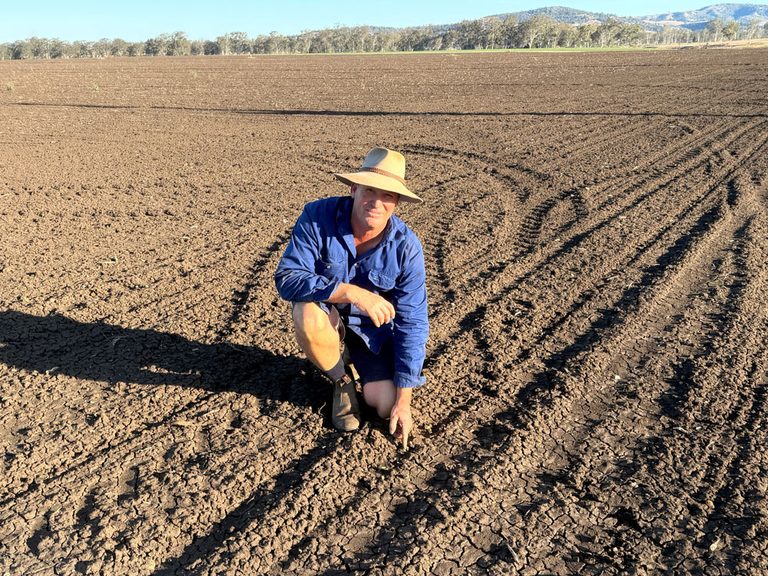
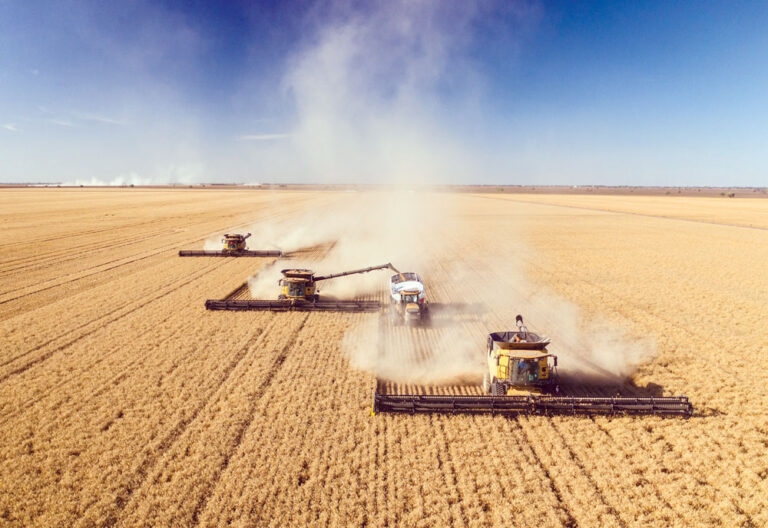
Early predictions for the 2026-27 winter crop are based around the amount of ground planted estimated at 23.6 million hectares
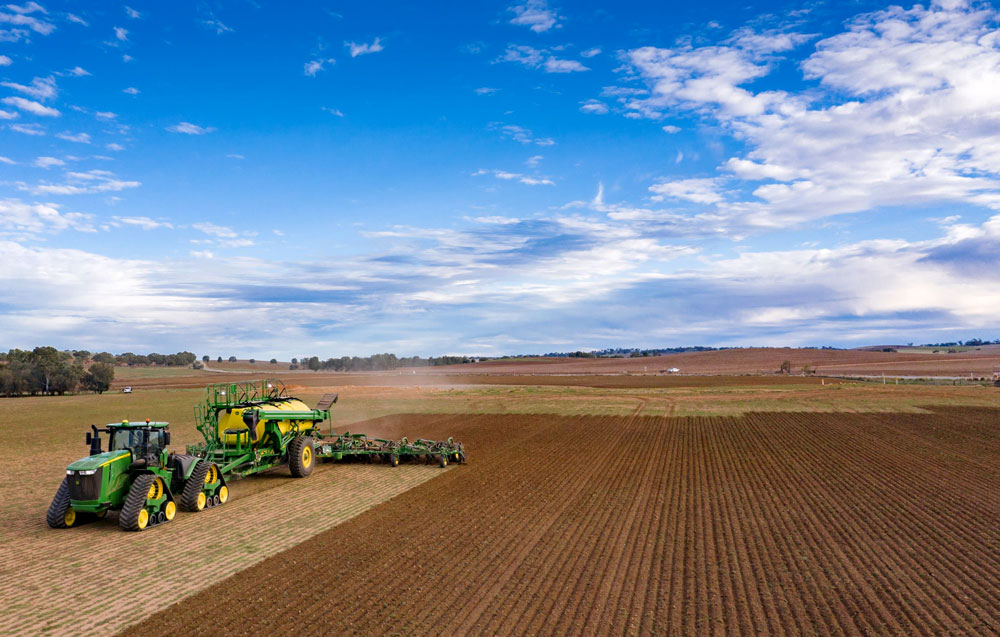
Many things just didn’t add up for cautious growers leading into the 2026-27 winter crop planting season.
They had just come off a record farmgate income of $101.4 billion from combined crop and livestock earning in the 2025-26 season, so there was money in the bank.
However, a USA/Israel surprise attack on Iran killed the country’s leader and with further bombings that followed threw the active shipping lane in the Strait of Hormuz into lock-down.
Growers contemplating how much ground they would plant had plenty to consider, as almost immediately fuel prices skyrocketed, and fertiliser costs increased without warning.
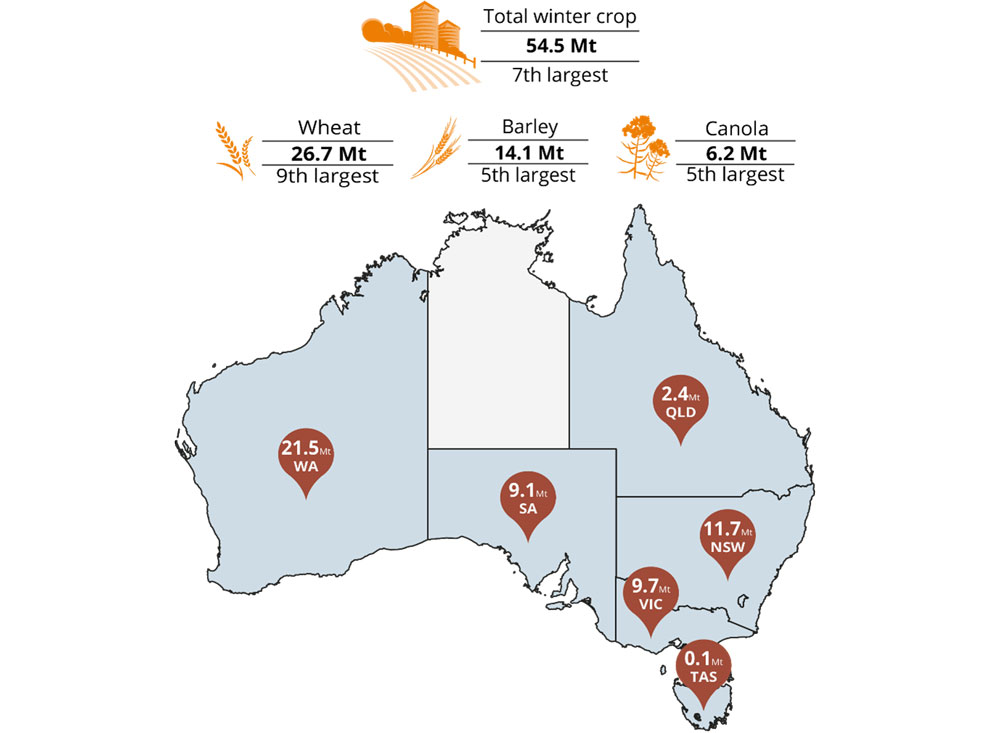
The well-considered expansion of cropping ground over the past few seasons that led to a record 25.1-million-hectare planting for season 2025-26 was thrown into jeopardy and it was almost surprising that growers bit the bullet and planted an estimated 23.6 million hectares nationwide for season 2026-27, according to early season forecasts.
Also at the back of some growers’ minds was the creeping temperature increase from an El Niño event brewing in the Pacific Ocean. Many remembered the last time an El Niño event struck down the winter crop harvest in season 2023-24, it wiped almost 22.0 million tonnes off the tally from the previous season in 2022-23.
Early season predication had to take these extraordinary circumstances into account, and since then the area planted for season 2026-27 has been revised up to 23.6 million hectares, with expectations of a 54.5 million tonnes harvest.
Western Australia
The area planted to winter crops in Western Australia in season 2026-27 is forecast to have marginally increase over last year to 9.1 million hectares, 7% above the 10-year average to 2025-26.
Growers in WA were coming off an all-time record from the previous season and was pretty much underway when average to above average rainfall in February and March boosted soil moisture profiles across major cropping regions, encouraging growers to slightly expand area planted year-on-year as well as plant early.
They paid little heed to the middle east conflict that would later ravage progress in unsown areas resulting in unfavourable wheat prices and higher input costs of fuel and fertiliser.
The main seasonal change for WA growers came in the guise of a reduced wheat area and expansion of their barley, canola, oats and pulse areas sown.
However, marginal cropping areas, particularly in northern and central cropping areas of WA, are expected to be far more impacted and in some cases left fallow.
Despite good soil moisture supporting germination for early sowing, adequate and timely rainfall will still be required in the coming weeks to support germination and development of crops.
According to the three-month outlook from June to August 2026, issued by the Bureau of Meteorology, there is an increased chance of below average rainfall (60% to 80% chance) which if realised may impact yield potential.
The obvious uncertainties surrounding the winter harvestin Western Australia comes with a forecast fall of 21% to 21.5 million tonnes in season 2026-27, compared to the record production levels of 27.2 million tonnes achieved in 2025-26.
This predicted result is 6% below the 5-year average to 2025-26, but still 11% above the 10-year average.
The forecast year-on-year decrease in production is largely attributed to lower yields more than offsetting a marginal increase in area planted.
Winter crop yields are also forecast to fall by 21% in 2026-27 but remain 5% above the 10-year average to 2025-26, reflecting good soil moisture profiles at sowing but a drier outlook.
While it is expected that growers will have full access to fertiliser requirements for the sowing period, there is more uncertainty surrounding their willingness to purchase fertiliser at elevated prices for top-dressing which could impact yields.
To curb this impact, growers may rely on cheaper fertiliser options or ration current fertiliser stocks, shifting their application to crops with more favourable margins like canola or barley rather than wheat.
A breakdown of expectations from crop varieties in WA places wheat production down 29% to 9.47 million tonnes, barley production down 14.7% to 6.4 million tonnes, canola down 20% to 3.4 million tonnes while the only hold about their own from last year is Lupins up 7.6% to 1.98 million tonnes.
New South Wales
Growers in New South Wales were caution from season start and as a result the area they planted to winter crops is forecast to be down by 22% in season 2026-27 to 5.3 million hectares, 9% below the 10-year average to 2025-26.
Low soil moisture and rainfall throughout autumn combined with concerns about higher input costs resulted in many northern growers reducing area planted to winter crops.
In addition, many growers across New South Wales have grain in storage from previous seasons which is likely to be sold down to support cashflow, providing a further disincentive to plant in 2026-27.
The area planted to wheat is forecast to be down 22% year-on-year, 14% below the 10-year average to 2025-26.
While barley area is forecast to be down 10%, with lower input requirements, improved performance under drier production conditions and demand from feedlots likely to support plantings despite low soil moisture.
Late May rainfall across northern regions may encourage more area to be planted depending on rainfall totals received and seed and fertiliser availability.
As the ideal planting window for canola closed without a significant rainfall event in northern cropping regions, growers are likely to have switched into barley.
Very dry conditions during April are expected to result in a 32% year-on-year fall in area planted to canola. However, rainfall events throughout late May in southern cropping regions are likely to have supported area planted to canola in the south.
Winter crop productionin New South Wales is forecast to decrease by 37% to 11.7 million tonnes in 2026-27, 13% below the 10-year average to 2025-26.
A poor start to the winter cropping season across northern regions resulted in many growers’ reducing area planted to winter crops.
Rainfall across the Northwest, Northern Tablelands, Central West and northern parts of the Riverina around Griffith has been below the 20th percentile in the year to mid-May, severely limiting soil moisture availability.
In contrast, the Murray region and eastern parts of the Riverina have received average rainfall throughout the year to May. The winter rainfall outlook is not favourable, with an increased chance of below average rainfall across most major cropping regions.
Early winter crop yield predictions are indicating an average of 2.2 tonnes/hectare in 2026-27, 1.3% below the 10-year average to 2025-26. This reflects the dry conditions in northern New South Wales and the negative winter rainfall outlook.
The three-month outlook, issued by the Bureau of Meteorology from June to August 2026 indicates that there is a 60-80% chance of below average rainfall for cropping regions across most of New South Wales.
Further cause for concern is the increasing threat from the El Niño and or positive IOD event emerging throughout 2026. There is a likelihood of further downside potential for winter crop production across New South Wales.
Growers’ expectations from crop varieties in NSW comes with some hellbent predictions with wheat production down 37.5% to 7.0 million tonnes, barley production down 30.3% to 2.3 million tonnes, canola down 34.4% to 1.05 million tonnes while the boom in chickpeas takes the biggest hit, down 66.1% to of Christmas lunch portion of just 1.33 million tonnes.
Victoria
Growers in Victoria were completely blinkered by the favourable conditions at season start and went on to increase the area planted to winter crops by 16 thousand hectares in 2026-27, some 5% above the 10-year average to 2025-26.
Taking full advantage of the favourable start to the season, the area planted to barley and canola is expected to increase by 8% and 2% respectively as growers seek to maximise margins in response to rising input costs, while area planted to wheat is expected to be down by 4%.
While the area planted to lentils is expected to increase to 533 thousand hectares, 70% above the 10-year average to 2025-26, as growers incorporate pulses as nitrogen fixing crops.
The three-month outlook for June to August 2026, issued by the Bureau of Meteorology indicates there is a 70-80% chance of below average rainfall for most of Victoria. Despite the increased chance of below average rainfall, many cropping regions are still expected to receive sufficient June rainfall to support crop germination and early establishment.
Victorian have been blessed with the second-best season-to-season winter crop productionforecast with a 9.7 million tonnes harvest, down just 4% from 2025-26, and still 10% above the 10-year average to 2025-26.
Above average rainfall in late February and March improved soil moisture and supported earlier sowing. Favourable topsoil and lower layer soil moisture are expected to support the germination and establishment of planted crops.
However, adequate and timely winter rainfall will be particularly important across the west and north of the state, where a high proportion of winter crops are grown.
Winter crop yields are forecast to decrease by 4% in season 2026-27, easing from recent levels but remaining 4% above the 10-year average to 2025-26.
Current stored soil moisture in key growing regions is expected to support yields. However, if the climate outlook of dry conditions worsens there is further downside potential for average yields. Reduced urea application may also limit production.
Bank managers are expecting growers accounts to remain in big smile territory with high expectations crop returns will be similar to last year. Wheat production is expected to be about the same at 4.21 million tonnes, barley production down a fraction at 8.5% to 2.83 million tonnes, canola down a mere 5.4% to 1.18 million tonnes while lentils is trending well only down by 1.5% to 0.911 million tonnes.
South Australia
Growers in South Australia just needed a lucky break in the weather to get their farm operations back to full production levels and that break came with above to very much above average rainfall in late February and March throughout most of the state, with eastern parts receiving record March rainfall.
Growers were quick to act and planted down 4.1 million hectares to winter crops in 2026-27, an increase of 2% above last year.
This total crop area is 8% above the 10-year average to 2025-26 and, if realised, will be the third largest area planted on record.
Due to the favourable start, the canola planted area is forecast to increase by 4% and barley forecast to rise by 5%, driven by strong gross margins and barley’s lower input requirement compared to wheat given the projected below-average rainfall outlook.
Wheat area is forecast to be similar to the area planted last year as growers in marginal areas who were unable to plant due to low rainfall in the previous two years have opted to plant wheat, whereas growers in other regions are planting more barley at the expense of wheat due to margin pressure.
The Bureau of Meteorology’s three-month outlook for June to August 2026, suggests a 60-70% chance of below average rainfall throughout most South Australian cropping regions, including the Eyre Peninsula and the Upper North. The Yorke Peninsula and parts of the Southeast are expected to have a 70-80% chance of below average winter rainfall.
Winter crop productionin South Australia is forecast to remain stable at 9.1 million tonnes in 2026-27, supported by an increase in planted area.
Following the favourable start to the season, there is the possibility of below-average winter rainfall forecast and a possible effect from the El Nino and/or positive IOD event. This is weighing on forecast winter crop yields, that are expected to decline year-on-year. Despite this, the production forecast is still 13% above the 10-year average to 2025-26.
Under the forecast rainfall outlook, winter crop yields in South Australia are forecast to fall by 2% to 2.2 tonnes/hectare in 2026-27, however, average state yields are expected to be 5% above the 10-year average to 2025-26.
While soil moisture levels have been boosted by autumn rainfall and will support the establishment of crops, the negative rainfall outlook for winter could limit yield potential.
This contrasts with last year, season2025–26, that started with low soil moisture and received timely rainfall throughout the season. However, current yield expectations for the 2026-27 season will be highly reliant on winter rainfall to support germination and winter growth.
The initial breakdown of expectations from crop varieties in SA reads the best of all states and places wheat production barely down 1.6% to 4.66 million tonnes, barley production up by 1.5% to 2.17 million tonnes, with lentils stepping up by 6.3% to 1.18 million tonnes. While canola is forecast down 3.1% to 0.533 million tonnes.
Queensland
It appears growers in Queensland were content with a rest following their record winter harvest of 3.88 million tonnes last year.
The area planted to winter crops in Queensland is forecast to fall by 18% to 1.3 million hectares in 2026-27, still 3% above the 10-year average to 2025-26.
Among the biggest varieties, the area planted to wheat and barley is expected to fall by 19% and 14% respectively, both below the 10-year averages to 2025-26. While the ground planted to chickpeas is expected to fall by 19% in 2026-27 but remain 26% above the 10-year average to 2025-26.
Winter crop production in Queensland is forecast to fall by 38% to 2.4 million tonnes in 2026-27. The expected fall reflects a year-on-year fall in area planted and lower expected yields. This production outcome would be 3% below the 10-year average to 2025-26 of 2.5 million tonnes, reflecting low soil moisture levels at planting and an unfavourable rainfall outlook.
Winter crop yields are forecast to fall by 25% to around 1.8 tonnes/hectare in 2026–-27, similar to the 10-year average to 2025–-26. The three-month outlook from June to August 2026, issued by Bureau of Meteorology indicates a 60%-75% chance of below median rainfall across most of Queensland.
Average to below average soil moisture levels at planting, combined with an unfavourable rainfall outlook for winter, are expected to weigh on yield prospects.
A breakdown of expectations from crop varieties in Queensland places wheat production in the worst position, down 42.9% to 1.32 million tonnes, barley production down 32.0% to 0.350 million tonnes. While chickpeas is expected to be down 33.3% to 0.650 million tonnes.