BKT has released tyres designed for electric powered tractors using advanced technologies in a product range especially for electric mobility

BKT has officially kicked off its range of tyres specifically made for electric driven tractors and other farm vehicles with a range of 70 series Agrimaxfactor tyres, imprinted with the E-Ready logo.
And this is just the start as the E-Ready design will be extended to all products in this category in the future.
E-Ready specification represents a breakthrough, the beginning of a path toward delivering solutions suitable for electric mobility.
It also aims to underscore BKT’s commitment to sustainability, a goal toward which every responsible business must direct research and investment. By stylising an E-Ready logo, BKT seeks to showcase its aptitude for anticipating market needs through the robustness of its advanced technology.
As electric-powered tractors become a reality it has been necessary to design a tyre that follows the peculiar changes in the way that electric vehicle run, much different than for a conventional model.
There are many differences, trials and paddock tests have revealed that in order to equip an electric vehicle, designers need to take into account the factors that characterise electric mobility, such as weight, engine structure, range and lack of noise.
Electric vehicles weigh more because their batteries can add up to 30% extra weight, and this is something that really affects the way a tyre works.

Not only are Electric vehicles heavier, but they also run differently than vehicles powered by diesel or natural gas.
Operators soon find out that Electric vehicles can immediately hit maximum power just by stepping on the accelerator.
This means load shifts can be faster and more intense than in conventional vehicles, with a consequent effect on tyre wear.
Energy autonomy also plays a decisive role. If an electric vehicle is designed for energy savings, tyres should also be designed not to affect vehicle consumption, such as the case with rolling-resistant tyres.
Manufacturers are investing heavily in research into Electric vehicle/tyre consistency, even in terms of noise.
That’s why designing and developing tyres suitable for electric mobility takes a specific path that differs from combustion-powered vehicles.
Let’s explore the characteristics of tyres designed for electric vehicles in greater detail.

Electric tyre weights and sizes
Electric vehicle tyres have to bear a heavier weight as the vehicle they are equipping will in most cases be laden by batteries that can increase the weight by as much as 20 to 30%.
This factor calls for greater stress resistance and in turn a more robust structure, starting with reinforced belts and casing, to a different and specific sidewall and bead design.
Electric motor variations
A few additional differences that distinguish an electric vehicle tyre from a conventional one include the ability to withstand higher drive torque, especially at the start. I
An electric motor gives more thrust to the mechanical transmission, and in turn to the wheels, than a conventional vehicle, resulting in greater start acceleration.
This means that it is absolutely necessary to revisit the tyre’s bead structure to ensure better grip on the rim, especially during acceleration. The tread must also be optimised, both in terms of design and compound.
Electrically powered vehicles have significantly more tyre wear than combustion engine vehicles, which is why a different design is needed to ensure an optimal life cycle.
Tyre autonomy
If the tyres mounted on an electric vehicle are inadequate, they can cause significant energy loss, since rolling resistance can contribute as much as 20% of the vehicle’s energy consumption.
To adjust the rolling resistance for electric vehicle tyres, without compromising any other performance functions, it is necessary to adapt the tread compound, tread pattern, and also the particular sidewall structure.
The most suitable tyres for electric vehicles are those that are designed specifically for the purpose and as a result are less energy intensive. In other words, a tyre whose advanced structure will not affect the electric vehicle’s range.
The noise factor
Noise is also something that tyre manufacturers have to particularly consider for electric vehicles. These tyres should have different tread patterns and compound compositions, both natural and synthetic.
The size will also significantly contribute to a tyre’s quietness.
With its team of specialised researchers, BKT has developed an ideal solution for the electric vehicle market through testing and prototyping. And that’s how the market was introduced to BKT’s first E-Ready tyre.
Agrimaxfactor tyre range
The Agrimaxfactor range of 70 series tyres is the first to bear the E-Ready imprinted logo.
This series of tyres is designed for both transportation and tillage operations.
With its unique technology and aesthetic design this high-performance tyre has a technically improved tread pattern for better rideability and smoother impact on the road.
BKT is now beginning to invest heavily in the e-mobility tyre segment. And while the centre of gravity of immediate goals may shift, innovation and a wide range remain the beacons guiding BKT into the future.
For more information about Agrimaxfactor 70 series tyres for electric models go to the website of Australian distributor Tradefaire here.
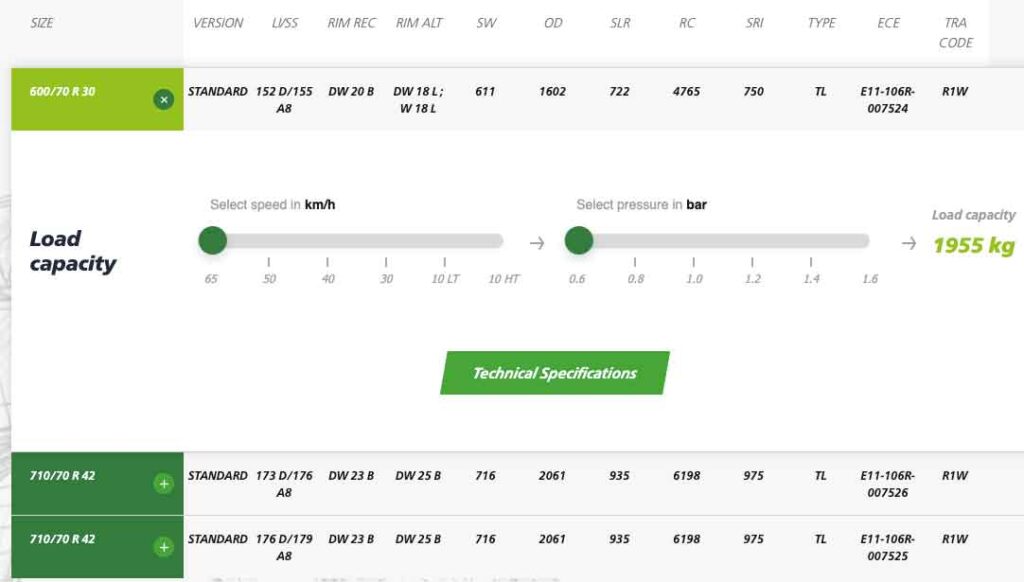
BKT 70 series Agrimaxfactor tyre specifications