While growers ducked a supply bullet for fertiliser but not a price hack this 2026-27 season thoughts turn to next season’s supply
The 2026-27 winter cropping season has been one of the most complicated for the past century with a mind-stretch well outside normal considerations.
Apart from soil moisture levels, rainfall outlook, an El Niño threat, cost of fuel, fertiliser and other inputs, growers were also confronted with a season that was machinated with outside interference.
Confronted with repercussions of the US/Israel attack on Iran on 28 February it dragged the livelihood of farmers into what is becoming one of the most costly and deadliest Middle East/US conflicts.
We are now at the stage where wholesalers are gearing up advance orders for fertiliser supplies for next season, 2027-28, with many finding their usual supply route blocked and having to seek other world supply options.

With their orders put in around October this year, for delivery in time for next season, supply guarantees are becoming somewhat urgent.
However, the Australian Fertiliser Corporation (AFC) has urged farmers to remain cautious about fertiliser availability and point to the fact there is currently sufficient urea supplies for top-dressing to carry crops through the current season.
But experts warn that while the urea supply is currently under control this season, as the main application period draws to a close. The more immediate challenge will be securing granular phosphate products – including DAP, MAP and SSP – for the 2027-28 winter season.
Clarification from the AFC
“Normally, Australian buyers would begin securing cargoes for spring application between October and January,” AFC CEO Stein Haugan explained.
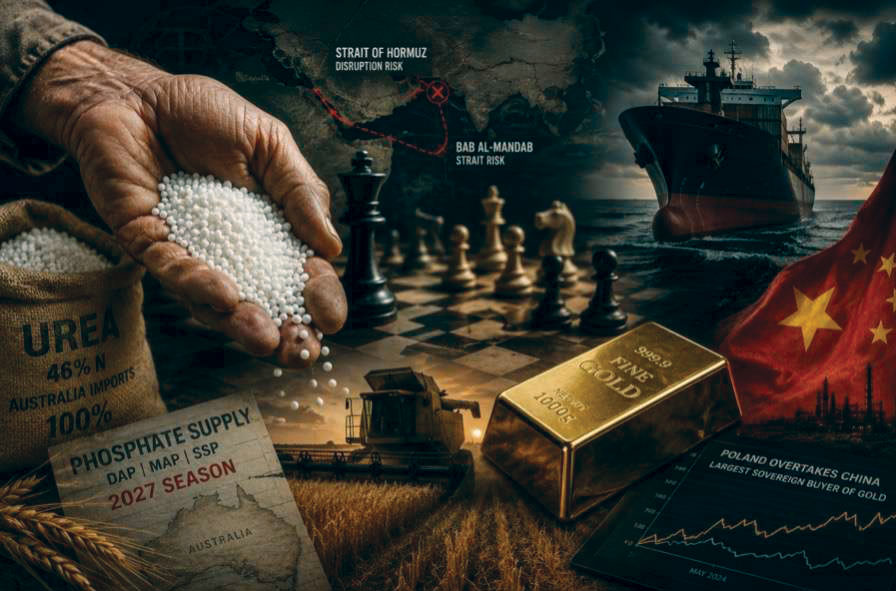
“This year, sulphur prices have risen dramatically, driven in large part by demand from nickel producers. The closure of the Strait of Hormuz has compounded the situation by severely restricting Saudi Arabian exports.”
In the latest escalation of the Middle East crisis, Iran-backed Houthi forces in Yemen announced a maritime embargo on Saudi Arabia on 20 July in retaliation for restrictions affecting Houthi-controlled ports and airports in north-western Yemen.
“With vessels already unable to move through the Strait of Hormuz, Saudi Arabia is diverting phosphate fertiliser shipments through the Red Sea,” Stein Haugan added.
“Any direct action affecting the Bab al-Mandab Strait would therefore have serious consequences for global fertiliser supply.”
“India and Australia are particularly exposed, with Saudi Arabia supplying significant volumes of DAP and MAP to both markets. Shipment times from Saudi Arabia to India could increase by as much as one month, and potentially even longer for Australia, if both the Strait of Hormuz and the Bab al-Mandab Strait were disrupted,” Stein Haugan confirmed.
Stein Haugan also outlined how China, traditionally an important supplier of granular phosphate products to Australia, was also operating at less than 50% capacity because of exceptionally high sulphur prices.
“Sulphur is a critical raw material in the production of granular phosphate fertilisers.”
“The principal alternative would be to source additional product from Morocco,” Stein Haugan proposed, “However, Morocco is itself a major importer of sulphur, while freight costs from Morocco to Australia are also a significant consideration.”
Longer-term production outlook
Despite the immediate supply risks, Mr Haugan said the longer-term outlook for global fertiliser supply remained encouraging.
QatarEnergy continues progressing one of the world’s largest fertiliser expansion projects. JPMorgan has arranged approximately US$1.6 billion in financing for a new nitrogen fertiliser complex in Basra, Iraq. Yara has expanded its North American footprint through the acquisition of a 1.3 million tonne-per-annum facility in Texas USA.
Kazakhstan has approved a US$1.6 billion fertiliser project near Aktau, while Petrobras has recommenced development of Brazil’s UFN-III nitrogen complex, expected to produce approximately 1.2 million tonnes of urea annually.
“Collectively, these investments demonstrate that governments, banks and global industry leaders are already positioning for structural growth in food production well into the next decade,” Stein Haugan contemplated.
“There are, however, two important counterpoints. Australia has now issued Level 3 travel advisories for Jordan, Oman and Saudi Arabia.

“In addition, the European Union Aviation Safety Agency has advised operators to avoid Gulf airspace. While the broader geopolitical picture is also sending important signals.
“In recent weeks, Poland overtook China as the world’s largest sovereign purchaser of gold. While not directly related to fertiliser markets, developments such as these provide valuable insight into how governments and global capital are assessing geopolitical risk.
“One lesson global capital markets have taught us over the years is this – the world’s largest pools of capital rarely announce their intentions.
“They do, however, leave a trail of footprints through the assets they quietly accumulate and the projects they quietly finance. Those prepared to follow that trail often gain a clearer understanding of where markets are heading.
“However, we should also remember that Australia imports 100% of its urea and sulphur requirements. And while I remain confident about the long-term outlook for global fertiliser supply. My concern is the period between now and when that additional capacity comes online,” Stein Haugan concluded.