How climate change, COVID-19, and the Ukraine-Russia war has disrupted the global agricultural market and raised concerns about the future of our food supply

If you want to know what countries in the world grow the most agricultural produce, and in what volume, and what they do with their product, and what it is worth, this article is a must read.
The University of the Potomac in Washington DC has released a report on where most of the world’s agricultural commodities are produced by country and in addition provides a list of the largest food producers and exporters worldwide.
The report gives an important insight into the state of the world’s food production and shows why it’s more important than ever to ensure peace prevails, because if not, many countries that rely on imports will quickly dip into food shortages that will be difficult replace.
Anytime you want to see a subject in more detail, such as the:
- Top agricultural products by country (mapped),
- Largest producing countries of agricultural commodities,
- Leading countries in the global export of crops and livestock.
See more information on key findings and in-depth data from the report on this link: https://potomac.edu/where-does-our-food-come-from/.
The Largest Agricultural producers and exporters
Food is one of the essential commodities that sustains life, so making sure agricultural commodities continue to flourish is very important for the security and health of the world population.
Agriculture currently accounts for 4.3% of the global GDP and is an integral component of international trade, with staple foods such as sugar, soybeans, and rice produced and exported worldwide.
But growth of the agricultural sectors has been hitting many roadblocks, elevated by climate change, the COVID-19 pandemic, and now the Russian invasion of Ukraine.
The invasion of Ukraine has disturbed the world food market, more than most would realise as Ukraine and Russia rank among the largest food producers in the world, with Ukraine being the largest producer of sunflower seeds (a crucial agricultural commodity in food production factories).
The invasion by Russia of Ukraine has heightened uncertainty among the world population as to just how secure the future of our food production can be relied upon.
To shed some light on where our food comes from and which countries trade most of it, we researched the newest data on agricultural production. Below, you can read our findings.
Key Findings from the research
- The most widely cultivated agricultural commodities worldwide are cow milk, sugar cane, corn, wheat, and rice. Cow milk is the top agricultural product in 37 countries, while wheat is the top agricultural product in 14 countries.
- Corn is the most produced crop globally with 1.1 billion tonnes, followed by wheat with 760.9 million tonnes and rice with 756.7 million tonnes.
- China, the United States, Russia, Brazil, and India, five of the world’s most dominant food producers, are also among the top ten countries in the global export ranks.
- Russia, the third-largest wheat producer, together with its neighbor Ukraine account for about 30% of all global wheat trade, making the region one of the major breadbasket regions.
- Russia cultivates over a third of global sunflower seeds, while a quarter of the total production comes from Ukraine.
- Currently, some of the most exported agricultural products globally are wheat, rice, soybeans, corn, barley, rapeseed, palm oil, sunflower seeds, and bananas.
- Brazil is the world’s main producer of soybeans as well as the biggest exporter, at 82.9 million tonnes, followed by US with 64.5 million tonnes, and then Paraguay at 6.6 million tonnes.
- China is the top producer of rice in the world with 211 million tonnes and exports 2.2 million tonnes into the world market. The majority of the rice produced in China is to meet their own population’s demands.
- The US produces 32% of the world’s corn, making it the top producer of this crop. The US is also the top exporter of corn and in 2020 it exported this crop to 73 different countries.
- China is the largest producer of eggs at 29.8 million tonnes, while the Netherlands exports 415.3 thousand tonnes of eggs annually, making it the largest exporter of this commodity.
- In 2020, soybeans were the highest value exported goods for the United States, when it reached an export value of $25.8 billion.
- In 2020, China was the lead producer of over 30 crops, including wheat, rice, tomatoes, and potatoes. Rice was the most produced crop, with 353.1 million tonnes in total.
Top Agricultural produce by country
While agriculture developed throughout the world, is further divided into different regions developed different crops. Globalisation has seen a shift in the cultivation and exportation of foods worldwide.
According to a study in 2016, over two-thirds of agricultural products in national diets worldwide originated from a more remote region. With the rise of technology in agriculture in the past 50 years, this trend has accelerated quickly.
For example, tomatoes originate from the Andes (Latin America), yet they are a staple food in many cuisines around the world. The biggest producers of tomatoes are countries such as China, India, and Turkey. At the same time, the Netherlands (a country nowhere near the Andes) is the biggest exporter of tomatoes.
Another example is wheat, which was initially cultivated in the Mediterranean and Central and West Asia. Today, wheat is produced in over 100 countries globally and ranks as the biggest agricultural commodity for over 14 countries.
As we see, the origin of food plays a small role in the food we get on our table. Today, countries worldwide have domesticated crops from remote regions that now directly contributed to the food security for communities worldwide.
However, with crop production exploding across all international level, it is interesting to discover which agricultural products are produced the most. The University of the Potomac report details their findings.

Top 7 most produced agricultural commodities worldwide
In the last two decades, the production of crops worldwide increased by over 53%, reaching a record high of 9.8 billion tons in 2020. While a plethora of agricultural commodities are produced worldwide, in 2019, only four crops accounted for half of the world’s agricultural production. Sugar cane tops the list with 1.9 billion tonness, accounting for 21% of the total output. It is followed by corn with 1.1 billion tonnes or 12% and rice and wheat with 0.8 billion tonnes or 8% each.
Top 7 agricultural products produced worldwide
The University of the Potomac report takes a closer look at most commonly cultivated agriculture produce in countries around the world.
1. Cow milk
Milk is one of the most commonly cultivated agricultural commodities in the world. There are 37 countries that list cow milk as their top agricultural product. Germany is one of the biggest milk producers, with over 33 million tonnes of milk produced every year. In monetary terms, this adds to a value of US$12.9 billion.
New Zealand is another big cow milk producer, with 21.9 million tonnes of milk produced each year, reaching a market value of $7.8 billion.
2. Sugarcane
While sugarcane originated in South and Southeast Asia, today, it is commonly grown in many regions worldwide, with 37 countries accounting for sugar cane as their top production crop.
Even though countries like Thailand, Pakistan, and Australia (where sugarcane originated) top the list in production, the subtropical climate of South America and Africa also creates a perfect environment for sugarcane production.
For production examples Latin American countries such as Columbia harvest 24.6 million tonnes, Cuba 13.8 million tonnes, Ecuador 11.1 million tonnes), and Bolivia 10.9 million tonnes are all big players in sugarcane. Alongside, in 2020 Mexico produced over 53.9 million tonnes of sugarcane, accounting for $2.4 billion in trade income.
At the same time, African countries harvested over 5% of total sugarcane production in 2020, with South Africa at 18.2 million tonnes), Egypt 14.9 million tonnes, and Kenya at 6.7 million tonnes being the main African producers.
3. Corn
Corn is the most produced cereal globally, with over 1.1 billion tonness produced in 2020. What led corn to become a widely cultivated crop is its easiness of cultivation, drying, storing, and transport.
Though it was first cultivated in Central America and Mexico, today, corn is grown in all continents, excluding Antarctica. In 2020, over 165 countries produced corn, with 16 listing corn as their most cultivated harvest.
The United States is currently the top producer of corn, with over 360 million tonnes harvested, holding a market value of $52.4 billion. The US is followed by China, which in 2020 harvested 260.8 million tonnes of corn. From the other side of the world, Brazil harvested over 103.9 million tonnes of corn, ranking as the world’s third-largest producer. Together, these three countries produced approximately two-thirds of the world’s corn.
Ukraine, another big player in corn production, cultivated over 30.2 million tonnes, valued at $5.2 billion in trade. While neighbouring Russia lists corn as its most produced agricultural product, with 13.8 million tonnes produced in 2020.
However, the Russian invasion of Ukraine in February 2022 put a halt to agriculture in Ukraine. At the same time, countries around the world are shutting off trade with Russia. This disruption saw the price of corn jump by 19.1% in March 2022 compared to the previous month.
4. Wheat
Since it was first domesticated in 9,600 BC, wheat has played a key role in food and nutritional security worldwide. Today, after corn, wheat is the most produced agricultural product globally, with over 760.9 million tons of wheat cultivated in 2020.
Its favourable cultivating characteristics has allowed wheat to become a valuable cash crop for countries in many parts of the globe.
In 2020, wheat was grown by 126 countries worldwide, while 13 of those markets had wheat as their most produced crop, including Russia, France, and Canada.
China is the world’s biggest wheat producer, with over 134.2 million tonnes of wheat produced in 2020, holding a $53.4 billion value in global trade. India is the second-largest producer, with over 107.5 million tonnes of wheat cultivated.
Russia, the third-largest wheat producer, harvested over 85.8 million tonnes of wheat. At the same time, its neighbour Ukraine is the 8th largest producer globally, with 24.9 million tonnes of wheat cultivated. Together they account for about 30% of the global wheat trade, making the region one of the major breadbasket regions.
Because of the region’s significance in wheat production, experts predict the ongoing Russian invasion of Ukraine will create a shortage of wheat supply in the following months.
The effects are already present, with wheat prices spiking to 19.7% in March 2022, compared to a month earlier. Since wheat is an essential raw material for the processed food industry, the increase can cause a ripple effect on prices for various foods.
5. Rice, paddy
About 13,500 years ago, the Chinese domesticated the first strains of rice. Since then, rice has become a staple food responsible for feeding half of the world’s population. It is cultivated in over 110 countries across the globe and in 2020 reached a total production of 756.7 million tonnes.
Asia produces 89% of the world’s rice, China being the world’s largest producer of rice with a 211.8 million tonnes harvested in 2020. India comes as the second-largest rice producer, with 178.3 million tonnes.
Rice constitutes the most produced crop for 12 countries, including Bangladesh (54.9 million tons), Myanmar (25.1 million tons), Cambodia (10.9 million tons), Nepal (5.5 million tons), and Sri Lanka (5.1 million tons).
6. Potatoes
Potatoes were first domesticated in the Andes region of South America. They were introduced to Europe by Spanish explorers, and from there, potato cultivation spread worldwide. Today, South American countries produce only 5% of the world’s potatoes.
In 2020, half of the world’s potatoes were produced in Asia, with China at 78.1 million tonnes, and India with 51.3 million tonnes being the world’s largest producers. At the same time, Europe supplied a little less than one-third of the world’s potato production, from which Russia produced 19.6 million tonnes and Ukraine with 20.8 million tonnes top the list.
The United States ranks as the fifth-largest producer, with a yield of 18.7 million tonnes of potatoes.
Since Russia and Ukraine combined account for one-tenth of the world’s potato production, the Russian invasion of Ukraine surged the market price for potatoes and other staple foods such as pasta, bread, and sunflower oil.
Experts predict the potato price will increase up to 30%, which automatically increases the price of many processed foods, including everybody’s favourite potato chip snacks.
Most Agriculture commodities by world region
Agriculture is the backbone of the world’s economic activity. In 2020, agriculture held a value of $3.6 trillion, an increase of $2.54 trillion from 20 years ago.
In the past two decades, South America, Africa, and Asia were the regions that expanded their agricultural production the most. During the period, the production capacities of Asia almost doubled from 3.3 billion tonnes to 5.1 billion tonnes.
At the same time, South America’s crop production surged twofold, from 748.4 million tonnes in 2000 to 1.4 billion tonnes in 2020.

7 top producing countries of agricultural commodities
In 2020, half of the global agricultural production came from Asia, with economies such as China and India being key players in the world sphere. Europe harvested one-tenth of the world’s agricultural production, with Russia, Ukraine, Spain, and Germany among the biggest producers.
At the same time, North America produced 826.9 million tonnes of agricultural product, equivalent to about 8.5% of the world’s aggregate output. South America supplied one-sixth of the world’s agricultural output, mainly coming from Brazil and Argentina.
To examine in more detail which countries produce most of the worldwide food, listed below are the seven largest global agricultural producers.
1. China
China is one of the largest agricultural producers in the world, with agricultural production of $1.1 trillion in 2020—a record high. Much of its success in agriculture comes from its vast geographical land, rich soil, and a large workforce. With less than 10% of the world’s arable land, China produces 25% of the world’s grain, making it a critical player in global food security.
In 2020, China was the lead producer of over 30 crops, including wheat, rice, tomatoes, and potatoes. Rice was the most produced crop in China, which reached a value of 353.1 million tonnes in total. While in the same year, China grew over 134.2 million tonnes of wheat.
In global trade, its wheat production is valued at $53.4 billion. China is also the top producer of potatoes at 78.1 million tonnes, tomatoes 64.7 million tonnes, cucumbers 72.7 million tonnes, and spinach 28.5 million tonnes.
Due to its rich soil, that makes harvesting more productive, China also ranks as the second-largest producer in the world for
- Corn (260.6 million tonnes)
- Chicken (15.1 million tonnes
- Bananas (11.5 million tonnes)
- Rapeseed (14 million tonnes)
2. United States
For a long period, the United States has been a significant player in agricultural production, due to its land composition, natural resources, and technological advances. In 2020 the US agricultural production accounted for $134.7 billion, about 0.6% of its national GDP.
In 2020, the United States was the world’s largest producer of corn at 360.2 million tonnes, harvesting about one-third of global production. It also produces over half of the global almond output and over one-third of global blueberry production.
The United States ranks as the top producer of cow milk at 101.2 million tonnes, chicken 20.4 million tonnes, meat 12.3 million tonnes, and sorghum 9.4 million tonnes.
In addition, the US is the second-largest producer in the world for:
- Soybeans (112.5 million tonnes)
- Sugar beet (30.4 million tonnes)
- Pig meat (12.8 million tonnes)
- Apples (4.6 million tonnes)
3. Russia
Over the past 20 years, Russia’s agricultural industry has been rapidly growing, with its production value increasing from $10 billion in 2000 to $85.5 billion in 2020. Due to investment and technological development, its cereal output turned Russia into a global player in food production, feeding over 2 billion people worldwide.
Today, Russia is the world’s largest producer of barley and sugar beets accounting for 13% and 14% respectively of the world’s total production. Russia also cultivates over a third of global sunflower seeds production and one-sixth of oats output.
In addition, Russia is the third-largest producer of wheat and rye. In 2020 alone, it produced over 85.8 million tonnes of grain and 2.3 million tonnes of rye.
4. Brazil
With rising global demands, technological advancement, and increasing prices, Brazil’s agricultural industry has been accelerating at a fast rate. In 2020, its agricultural production value reached $85 billion, a 30.4% increase from 2019.
To catch up with the rapid growth, Brazil is expanding its agricultural land, which in 2020 was about one-third of Brazil’s total area. The expansion constitutes a 22% increase from 9 years ago.
Brazil is known for its production of grains, cereals, beans, and oilseeds. In 2020, Brazil produced one-third of the world’s production of soybeans at 121.7 million tonnes, coffee 3.7 million tonnes, and oranges 16.7 million tonnes.
Almost half of global sugarcane production or 40.5% comes from Brazil, along with one-sixth of the worldwide meat production. It is also the third-largest producer of corn at 103.9 million tonnes, cow milk 36.5 million tonnes, and chicken at 13.7 million tonnes.
5. India
In 2016, the agriculture sector accounted for 23% of the country’s GDP, and 59% of the workforce made a living from agriculture. The agricultural industry is essential for India’s food and security as it is estimated that 70% of the rural population depends mainly on agriculture.
In 2020, India produced half of the world’s mango production at 24.7 million tonnes, and 20% of global wheat production at 107.5 million tonnes. A quarter of the global output of rice at 178.3 million tonnes, sugarcane 370,5 million tonnes, and bananas of 31.5 million tonnes came from India.
India also ranks as the second-largest producer of:
- Milk (87.8 million tonnes)
- Tomatoes (20.5 million tonnes)
- Potatoes (51.3 million tonnes)
- Oranges (9.8 million tonnes)
6. Spain
With favourable climate conditions and long history of agriculture cultivation, Spain continues to be a leading European producer, offering a vast array of agricultural produce. In 2020, the value of agricultural production in Spain was $54.4 billion, a 3.5% share of the country’s GDP.
Spain is well known for its vegetables and fruits. In 2020, over one-third of agricultural output came from vegetable and fruit cultivation.
Spain is also the world’s top producer of olives, with over 8.1 million tonnes of olives produced in 2020, accounting for 39.1% of total production.
Also, it is the second-largest producer of barley at 11.4 million tonnes, and peaches 1.3 million tonnes). It also produced one-tenth of the world’s almonds, reaching a market value of $507.6 million.
Grape cultivation in Spain is a tradition that today supplies the market with 6.8 million tonnes, making Spain the third-largest producer of grapes globally.
7. Ukraine
Ukraine is an agricultural superpower, and currently plants over two-thirds of its agricultural land, an area larger than New Mexico. The growth of Ukraine’s agriculture is partly due to its rich fertilised soil and modernisation efforts in the past decades.
In 2020, Ukraine was among the world’s largest producers of wheat, corn, sunflower seeds, barley, sugar beets, potatoes, and soybeans. Together, the production of these crops in Ukraine holds a market value of $21.4 billion.
Ukraine is the biggest producer of sunflower seeds at 13.1 million tonnes), harvesting over a quarter of the global sunflower production. That’s why since the beginning of the Russia invasion of Ukraine in February 2022, the price of sunflower oil has increased by 25%.
Considered one of Europe’s major breadbasket regions, Ukraine produces over 30.2 million tonnes of corn, 24.9 million tonnes of wheat, and 7.6 million tonnes of barley. Together these three crops account for $10.9 billion in the market.
In addition, Ukraine is also the world’s third-largest producer of potatoes and pumpkins, with about 21 million tonnes and 1.3 million tonnes respectively produced in 2020.
Most exported Agricultural commodities worldwide
As we have seen so far, not all crops are created equally, meaning some are more vital in providing food and nutritional security. At the same time, we can see that a group of countries produces most of the crops essential for feeding the world’s population.
Fortunately, due to globalisation, nations can exchange their goods and replace any gaps they may have in their own agricultural production.
Global trade in agricultural produce has been increasing rapidly, with its share of the total GDP of agriculture rising by 40% compared to 30 years ago. This means that the export and import of agricultural goods are expanding more rapidly than the global agriculture GDP. At the same time, with the rise of economies such as China, India, and Brazil, we are witnessing a shift in export patterns, turning developing countries into major global export players for agriculture. These economies have also increased their production capacities, meaning that they rely less on food imports.
Top 5 most exported agricultural produce
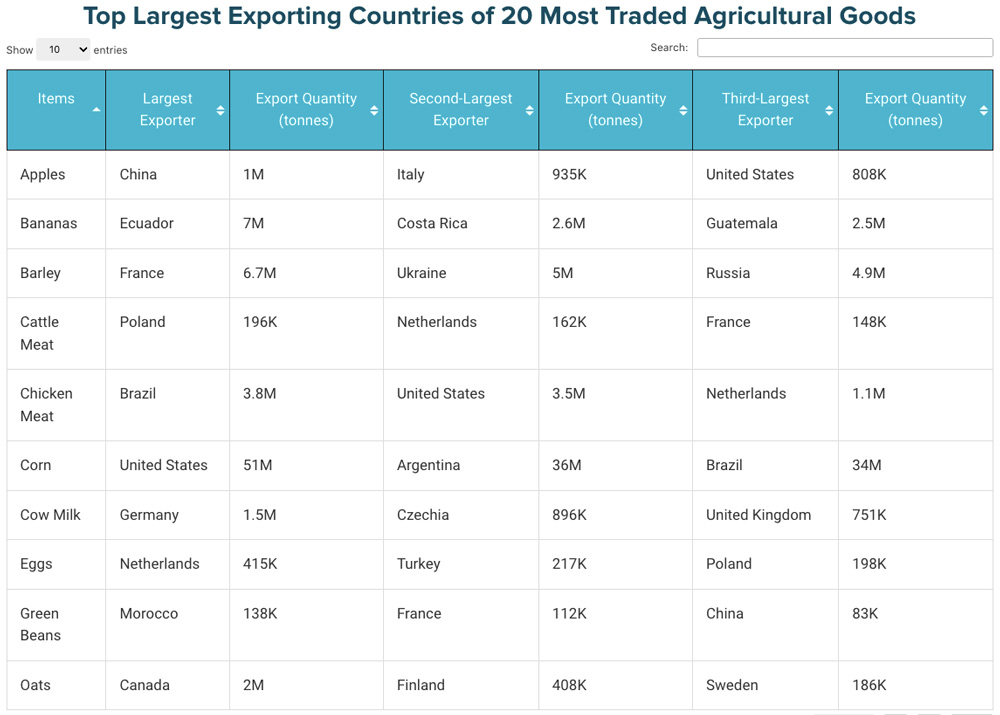
Today, some of the most exported agricultural products globally are wheat, rice, soybeans, corn, barley, rapeseed, palm oil, sunflower seeds, and bananas.
In 2020, the total exported quantities of wheat reached over 198.5 million tonnes, a quarter of total global wheat production. The largest exporter of grain was Russia at 37.2 million tonnes, followed by the United States 26.1 million tonnes and Canada 26.1 million tonnes.
Soybean is another major exported agricultural commodity into world markets. In 2020, the total export quantity of soybeans reached 173.3 million tonnes with a market value of US$64.1 billion. The biggest exporters of soybeans were Brazil with 82.9 million tonnes, the United States with 64.5 million tonnes, and Paraguay with 6.6 million tonnes.
Corn, a staple food in many countries worldwide, is an essential commodity for international trade, whose export market value for 2020 was $36.7 billion. The top three exporters of corn were the United States, with 51.8 million tonnes of corn exported; Argentina, with 36.8 million tonnes; and Brazil, with 34.4 million tonnes.
Rapeseed also is at the top of the list of agricultural exports. In 2020, over 25.1 million tonnes of rapeseed were exported worldwide. Most of the exported rapeseed came from Canada, which exported 11.7 million tonnes, followed by Ukraine with 2.3 million tonnes, and the Netherlands with 1.9 million tonnes.
Top countries in the global export of commodities
It is no surprise that the largest countries in the world are among the biggest producers of agricultural products. However, for countries like China, India, and Brazil, much of its output is dedicated to feeding their population, which means only a small amount is exported worldwide.
Yet, with the investments in agriculture technologies in the past decades, these countries are increasing their production capacities, allowing them to ship more agri-products to the global market.
As some nations become global players in food export, other countries become heavily dependent on trade with those countries. However, when the exporting countries have a low democracy index, exchanging goods with them becomes a risky move.
A shift in the policies, laws, and government in these low democratic-ranking countries would sprawl a food crisis among the nations that rely heavily on those exports.
1. United States
For a long period, the United States has been the world’s largest agricultural exporter. The position is due to the technological advances in the past few decades and that the US has a 0.811 democracy index, meaning that it is less risky for countries to rely on trade with the US.
In 2020, US agricultural exports were valued at $147.9 billion.
The US has a large assortment of agricultural products that exports, starting from corn of which they are the global export leader, to fruits, vegetables, and nuts.
In 2020, soybeans were the highest value exported goods for the United States, which reached an export value of $25.8 billion. Corn and wheat are other high-value exports for the US, which accounted for $9.5 billion and $6.3 billion of total value agricultural exports.
Other highly exported agricultural goods in 2020 include:
- Rice (1.3 million tonnes)
- Chicken meat (3.5 million tonnes)
- Sorghum (6.5 million tonnes)
- Apples (808.1 thousand tonnes)
2. Netherlands
Though the Netherlands is a much smaller country than the US, and ranks as the sixth-smallest country in the EU, it has become the largest exporter of agricultural products. In 2020, the total value of agricultural exports was $100.8 billion, increasing by $3.4 billion from the previous year.
Much of the Netherlands’ rise as a global agricultural exporter is attributed to its rich soil, enormous investments in farming technology, and ports being a central trade hub for Europe.
In 2020 Netherlands exported one-sixth of the world’s tomatoes and potatoes, with over 1.1 million tonnes and 2.1 million tonnes shipped worldwide. In the same year, the Netherlands was the largest exporter of eggs at 415.3 thousand tonnes and onions at 1.7 million tonnes.
Since less than one-third of the Netherlands’ exports account for the re-export of goods, the Netherlands now ranks as the world’s third-largest exporter of rapeseed at 1.9 million tonnes, palm oil 1.2 million tonnes, avocados 375.6 thousand tonnes), and chilies and peppers 467.4 thousand tonnes.
3. Brazil
It is no surprise that one of the world’s largest Agri producers also leads in the export. In 2020, Brazil’s agricultural exports reached $85.1 billion, a 6% jump from the previous year.
In 2020 Brazil exported over 82.9 million tonnes of soybeans or about half of the global soybeans trade. It is also a lead exporter of coffee, accounting for 30% of global exports of coffee. In 2020, its coffee export held a value of $4.9 billion. It also exported about 18% of the world’s corn, with $5.8 billion worth in trade.
In the same year, Brazil ranked as the second-largest exporter of rice at 518.4 thousand tonnes, and the third-largest exporter of mangoes at 243.4 million tonnes.
Yet, Brazil has a 0.599 democracy rank, which identifies its underdeveloped political culture as a risk factor for other nations that trade with Brazil.
4. China
Though most of China’s agricultural production goes to feeding its population, China continues to be among the largest agricultural exporters, with $67.2 billion worth of agricultural goods exported in 2020.
Food preparation materials and crude materials account for about one-fifth of their total export, with over $10.2 billion in market value. In 2020, it exported about 5% of the globally traded rice, with over 2.2 million tonnes shipped worldwide.
Moreover, China is a notable exporter of fruits and vegetables, such as apples at 1.1 million tonnes, pears 539.4 thousand tonnes, grapes 424.9 thousand tonnes, spinach 60.7 thousand tonnes, carrots 749.8 thousand tonnes, and leeks 70.2 thousand tonnes.
Though the world relies heavily on exports from China, its democracy index of 0.048 shows that its autocratic regime can be a considerable risk factor for other countries. It means that with a slight shift in its policies and the lack of free speech to object to it, China’s political environment can hinder trade with other nations, with the possibility of creating a food crisis.
5. Germany
Germany, a world economic power, is also among the largest global agricultural exporters, with over $79.5 billion worth of agricultural exports in 2020.
In 2020, Germany ranked as the world’s largest exporter of cow milk, sugar beets, and hops, which together hold a market value of $1.1 billion. In fact, over one-sixth of traded cow milk comes from Germany, while its sugar beet trade accounts for over two-thirds or 37.8% of the global export of sugar beets.
Germany is also the second-largest exporter of rye, exporting 265.2 thousand tonnes in 2020, accounting for 11.8% of the total rye trade in the world.
After its EU companion France and the Netherlands, Germany ranks as the third-largest exporter of potatoes globally, with over 1.9 million tons of potatoes exported in 2020, about one-sixth of the total trade of potatoes.
Anytime you want to see a subject in more detail, such as the:
- Top agricultural products by country (mapped),
- Largest producing countries of agricultural commodities,
- Leading countries in the global export of crops and livestock.
See more information on key findings and in-depth data from the report on this link: https://potomac.edu/where-does-our-food-come-from/.